


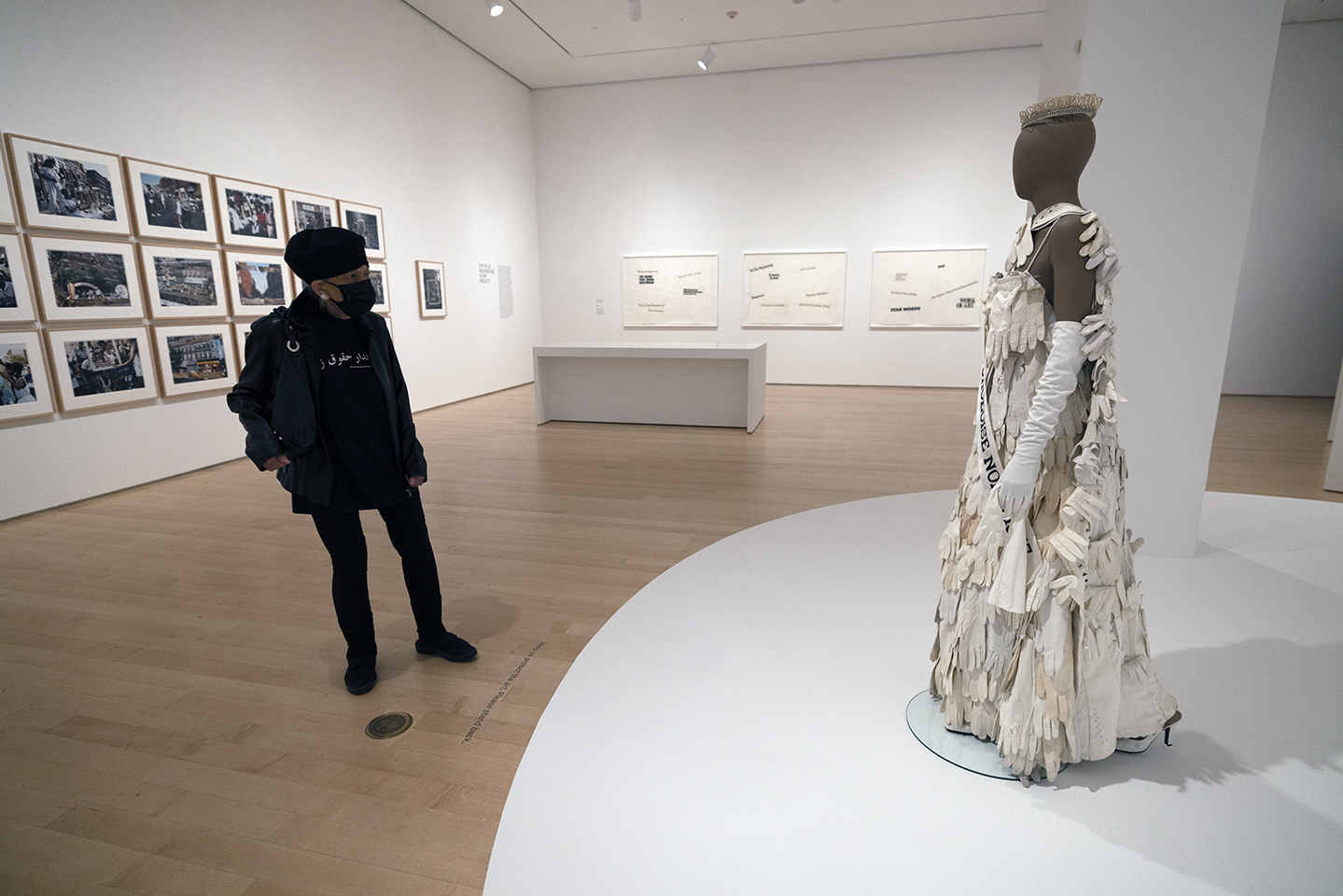
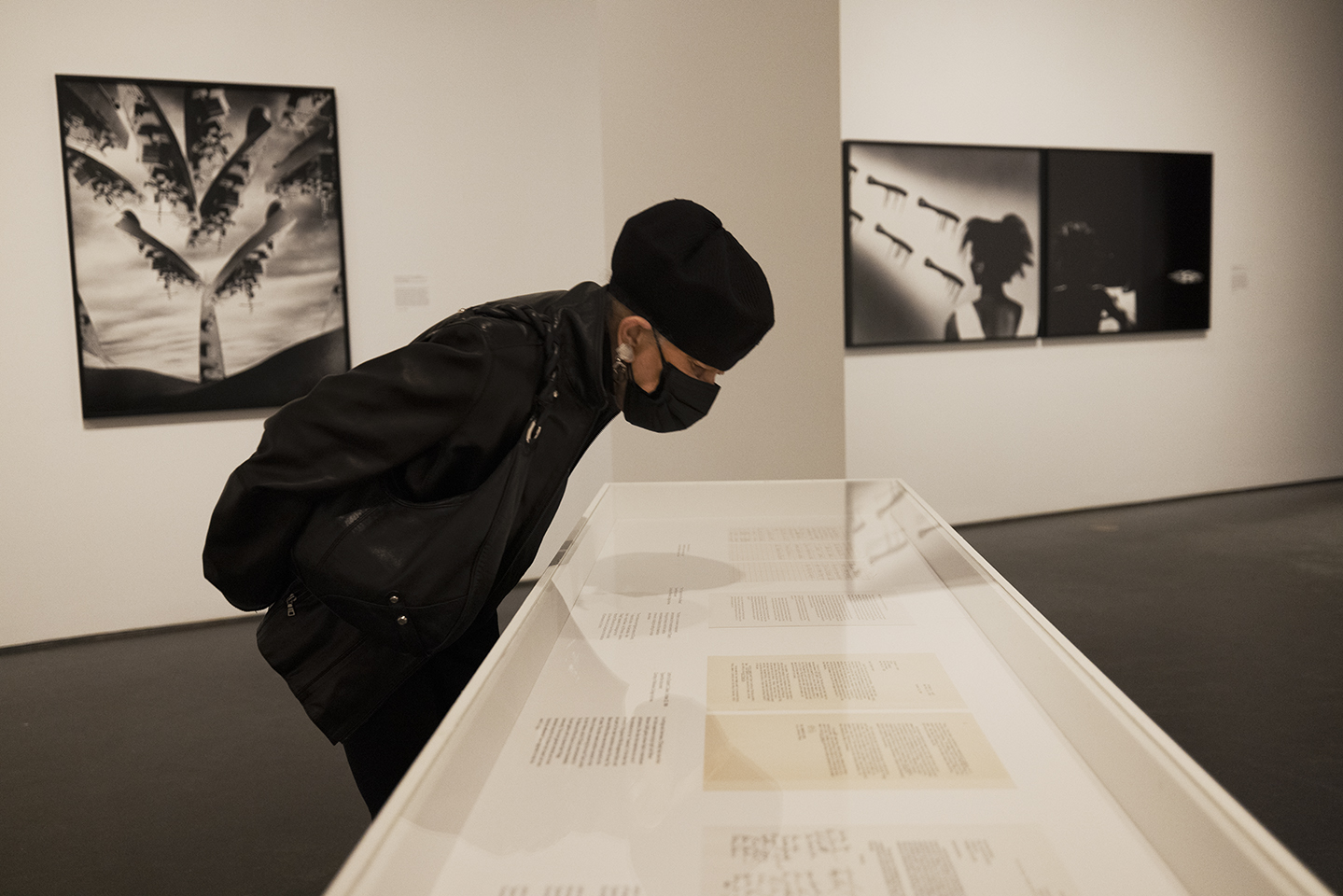
From Lorraine O’Grady’s Landscapes, ARC: Art, Recognition, Culture 1
“I don’t mean interracial sex literally. I’m really advocating for the kind of miscegenated thinking that’s needed to deal with what we’ve already created here.”
– Writing in Space, Introduction, p. xxix
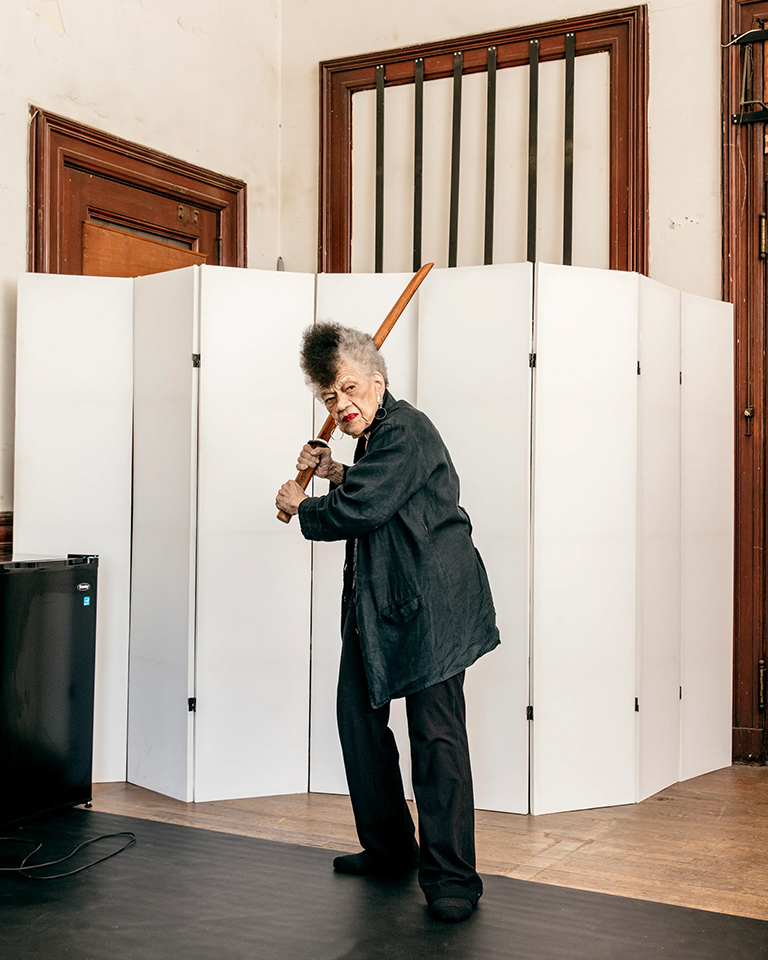
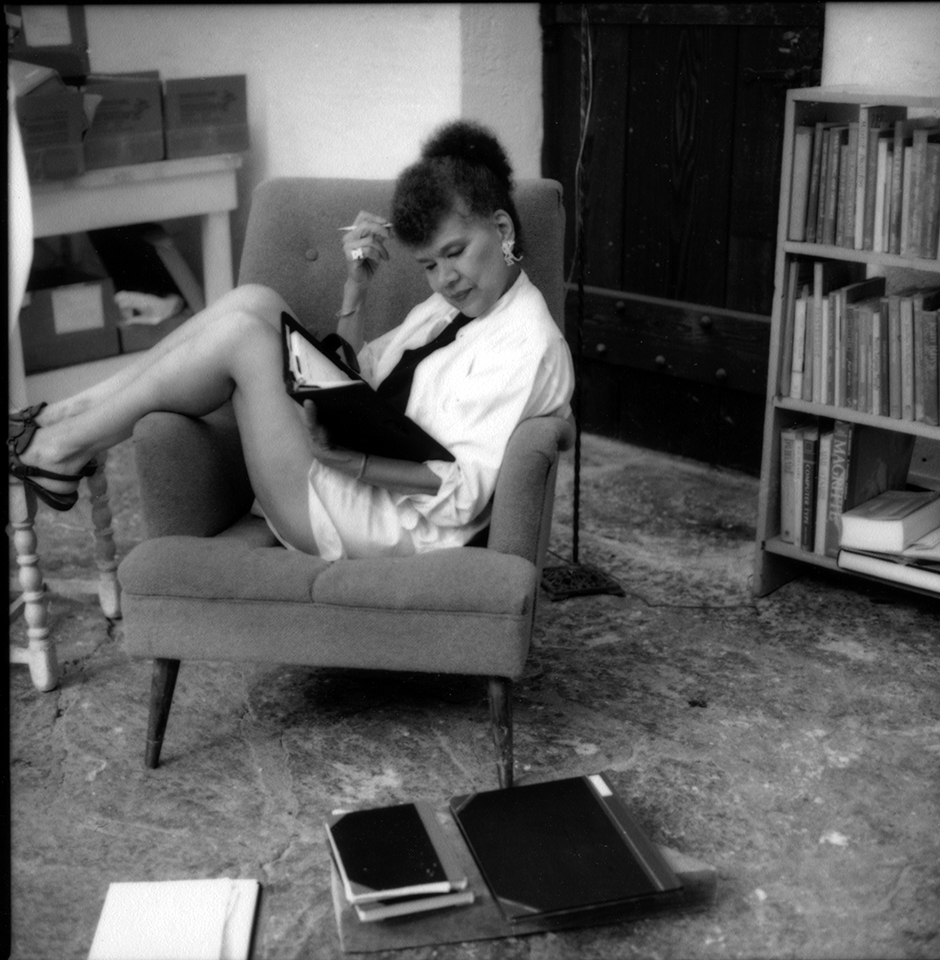
Lorraine O’Grady in her studio at Westbeth Artists Housing in New York City, 2022. Photograph by Stefan Ruiz for The New Yorker.
From Two Biographical Statements (2012 and 2019)
“Born in Boston to Jamaican immigrant parents, O’Grady was strongly marked by a mixed New England-Caribbean upbringing which left her an insider and outsider to both cultures. She has said, ‘Wherever I stand, I must build a bridge to some other place.'”
– Writing in Space, p. 3-4
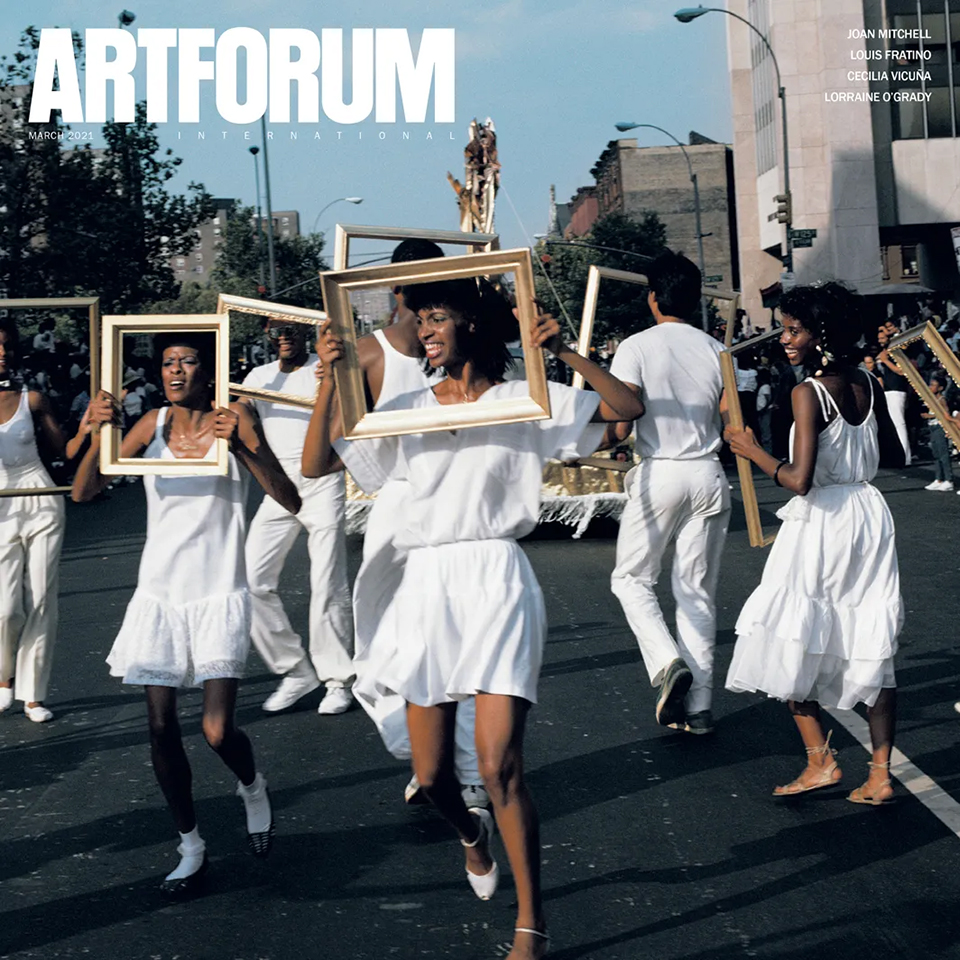
Art Is. . . on the cover of the March 2021 issue of Artforum.
From Cutting Out the New York Times (CONYT), 1977 (2006)
“For six months in 1977, I made a poem a week from the Sunday Times. Cutting out the National Inquirer would not have interested me. This wasn’t about condescending to the culture, it was about taking back from it. [The language] was raw material.”
“When he read the cut-outs, my ex-husband said it had been like leafing through the Times and coming across a photo of me accidentally. I never bought the Sunday Times again.”
– Writing in Space, p. 7
From Statement for Moira Roth re: Art Is…, 1983 (2007)
“Reading back through 20 years of an archive is like passing yourself on a train going in the opposite direction.”
“When I was a teenager in the late ‘40s growing up in Boston, I would devour magazines with pictures of girls in long black skirts, black turtlenecks, and black berets drinking espresso and puffing on cigarettes in 4th Street cafes.”
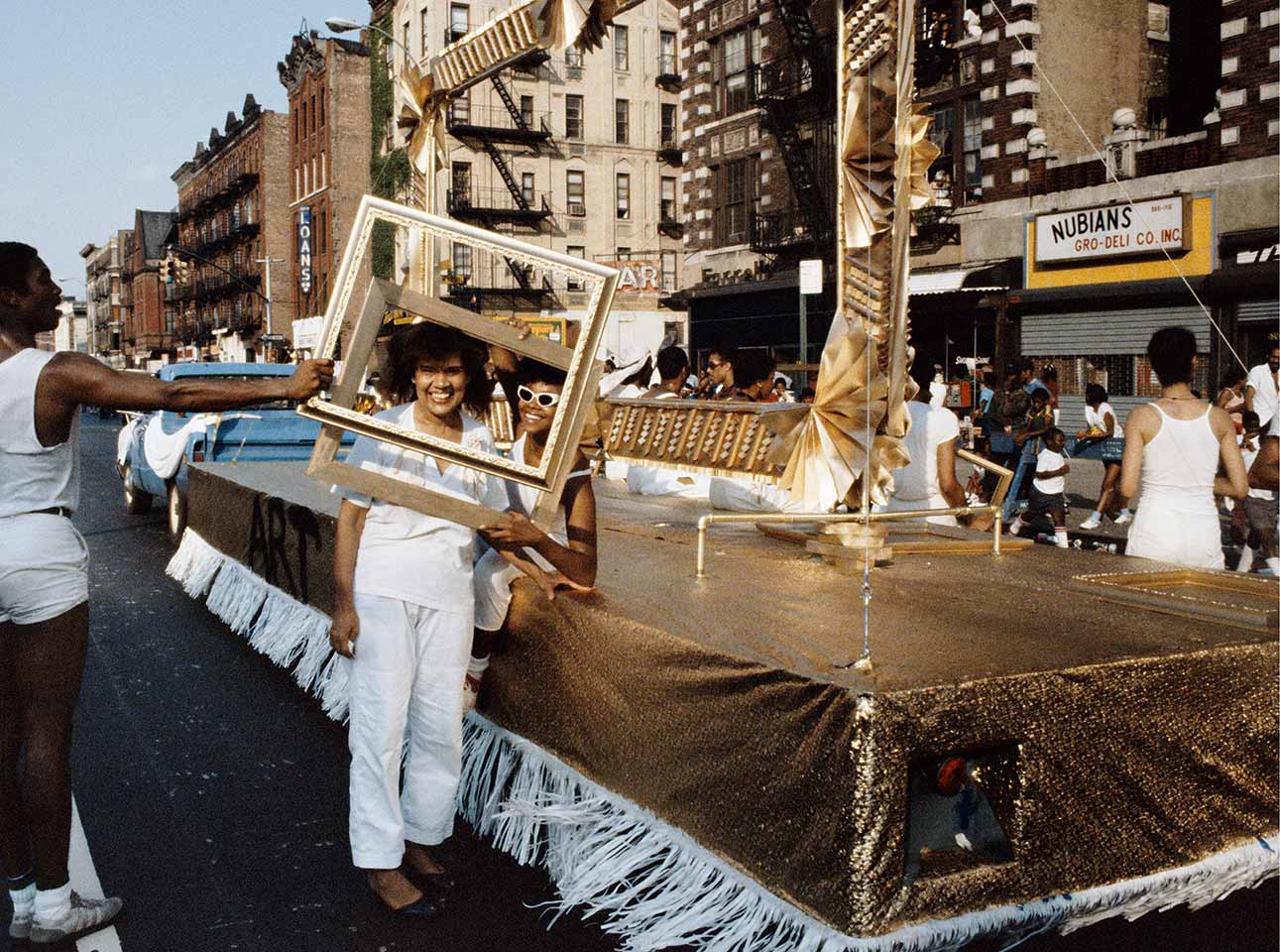
“Perhaps because I am West Indian and a great believer in Carnival, the idea of putting avant-garde art into a parade came to me.”
– Writing in Space, p. 23-24
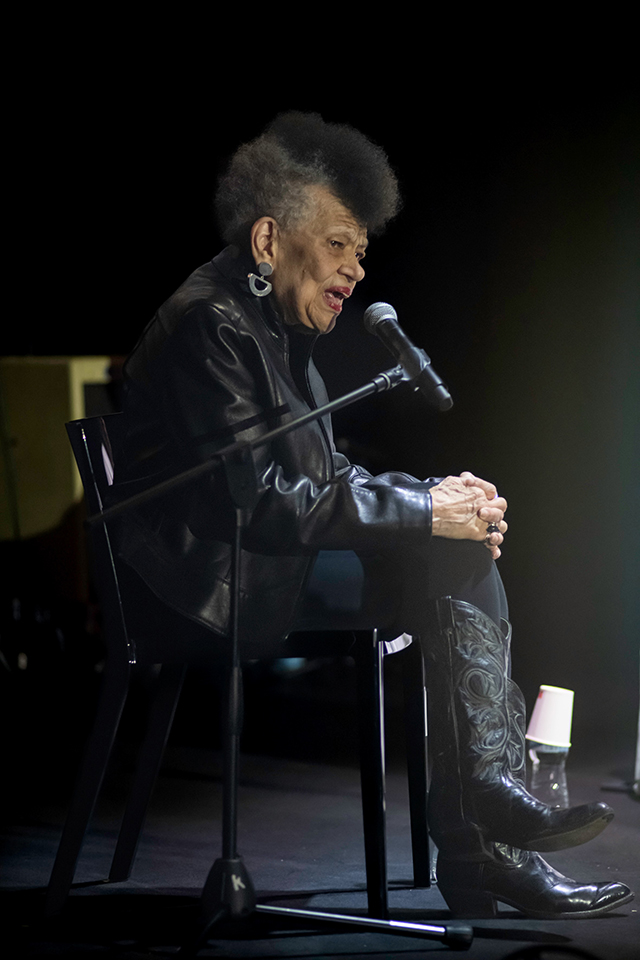
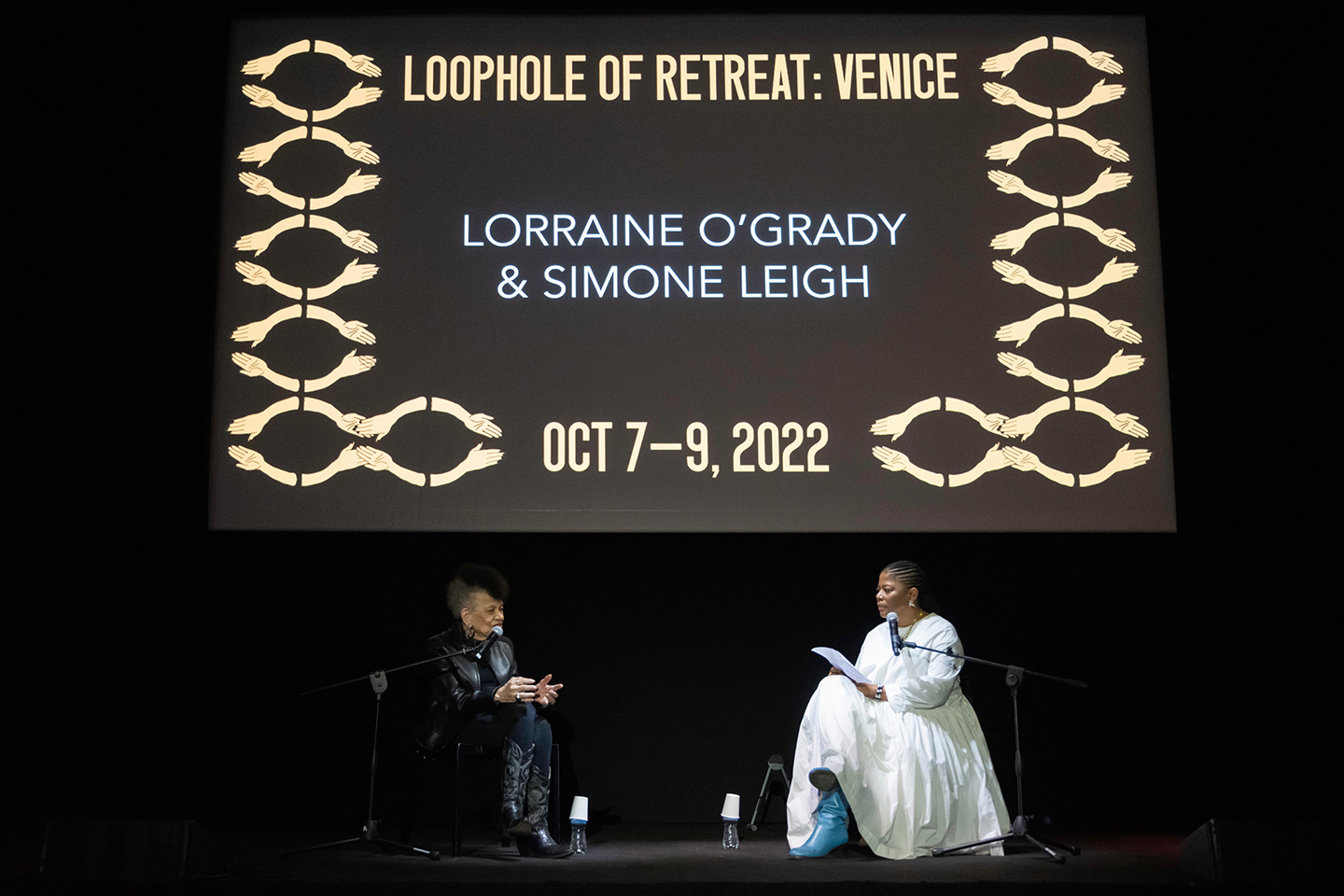
O’Grady during the artist talk for Loophole of Retreat, Simone Leigh’s exhibition at the 59th Venice Biennale, 2022.
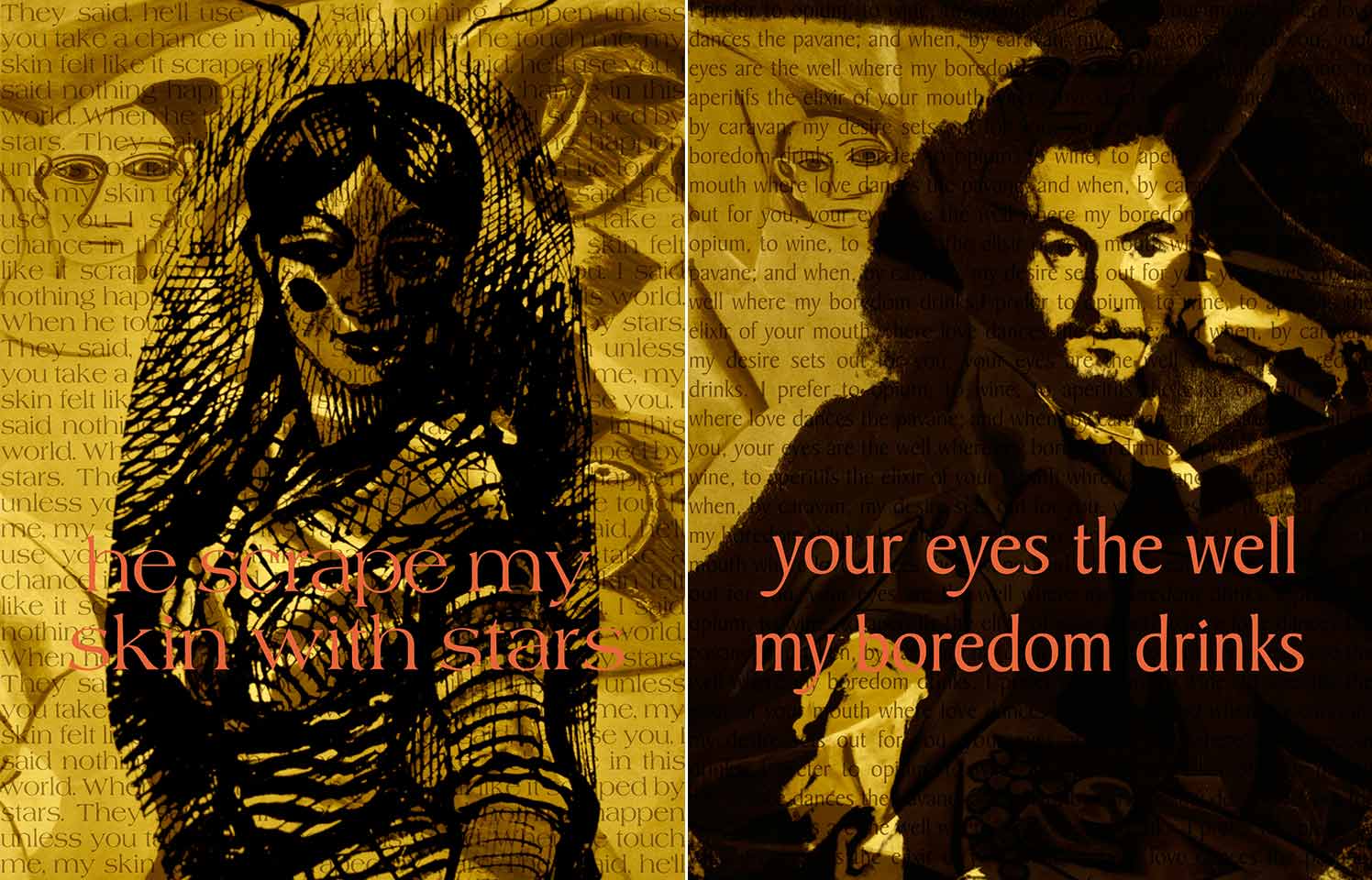
From Studies for a Sixteen-Diptych installation to be Called Flowers of Evil and Good, 1995-Present (1998)
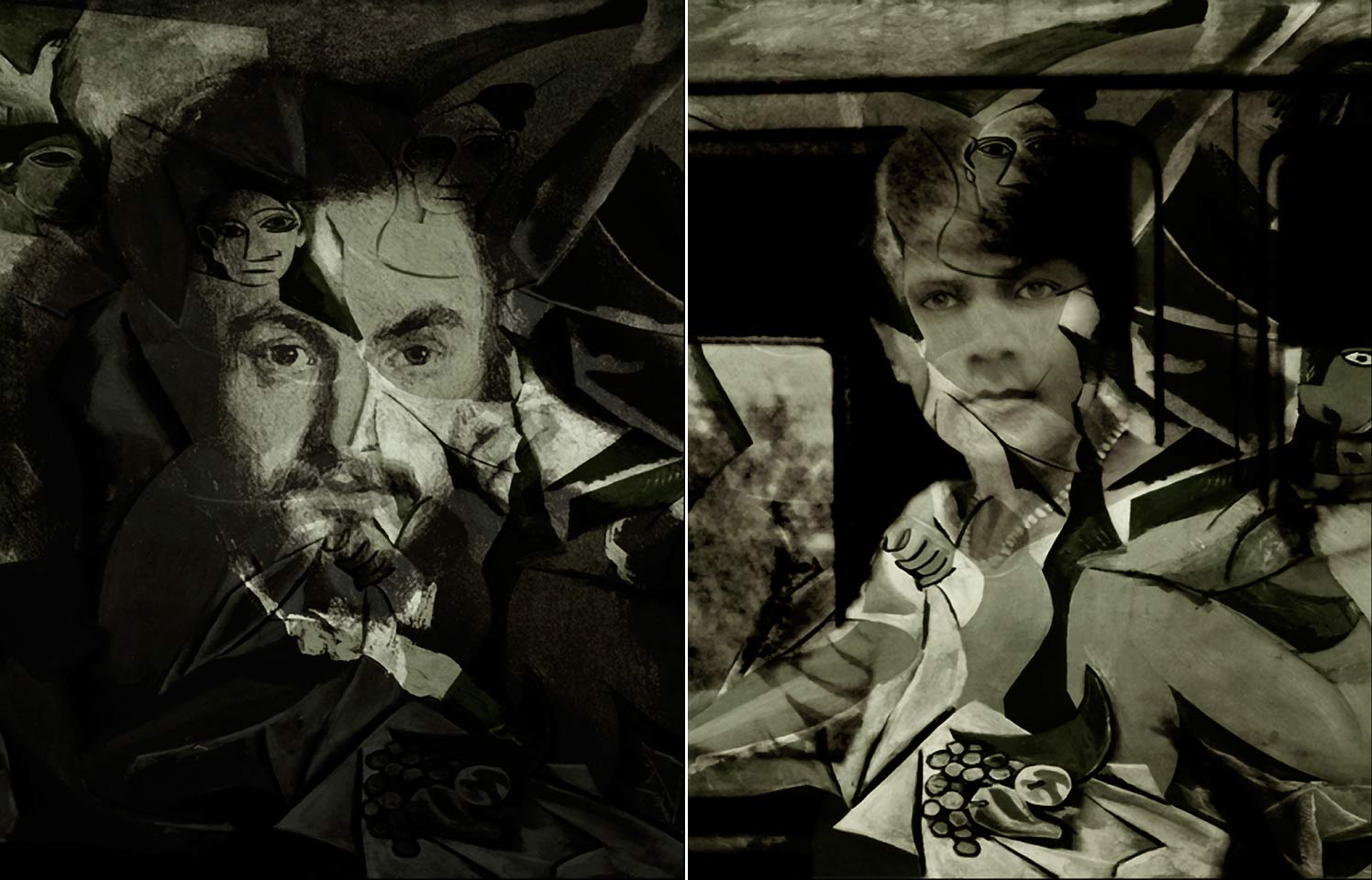
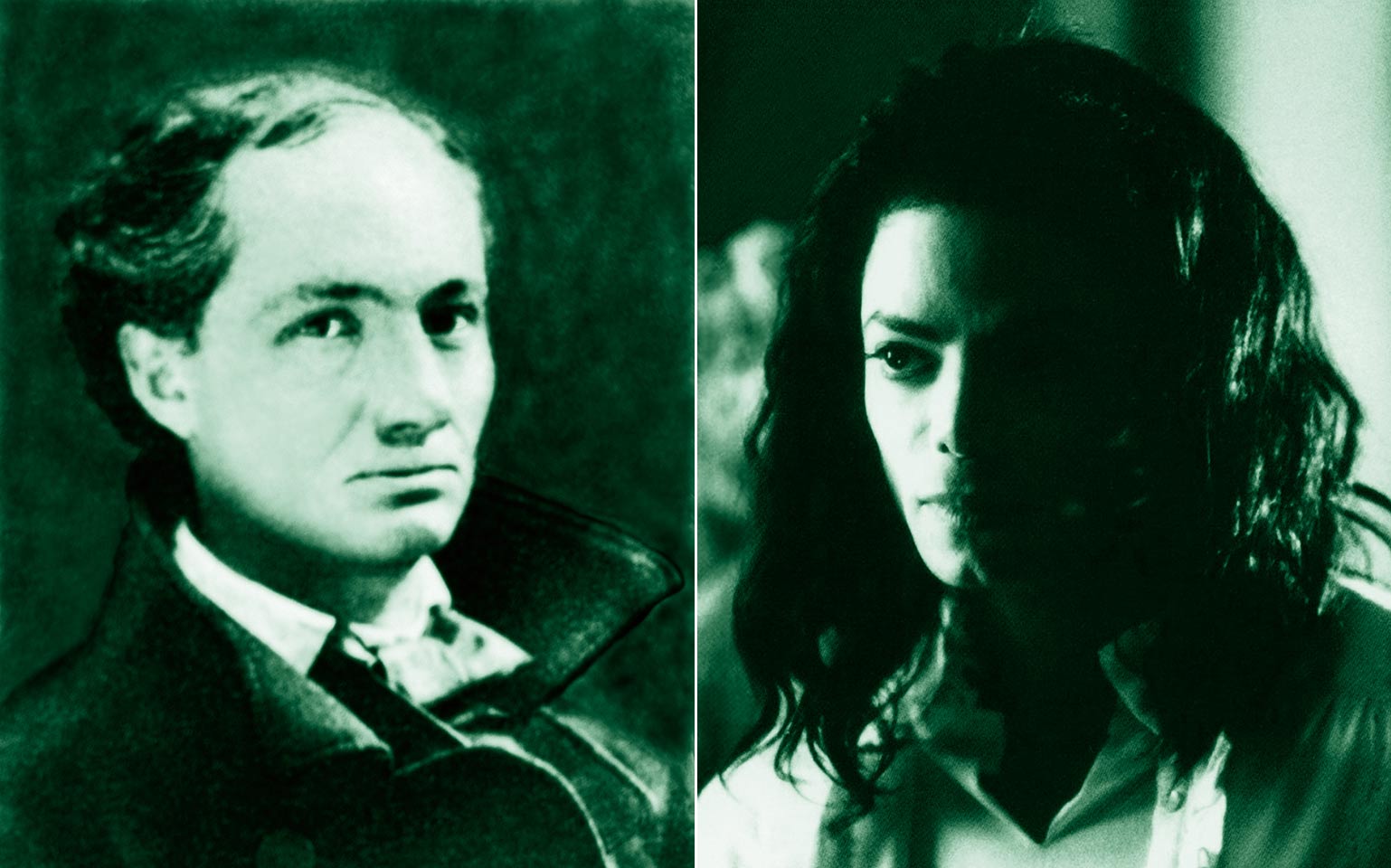
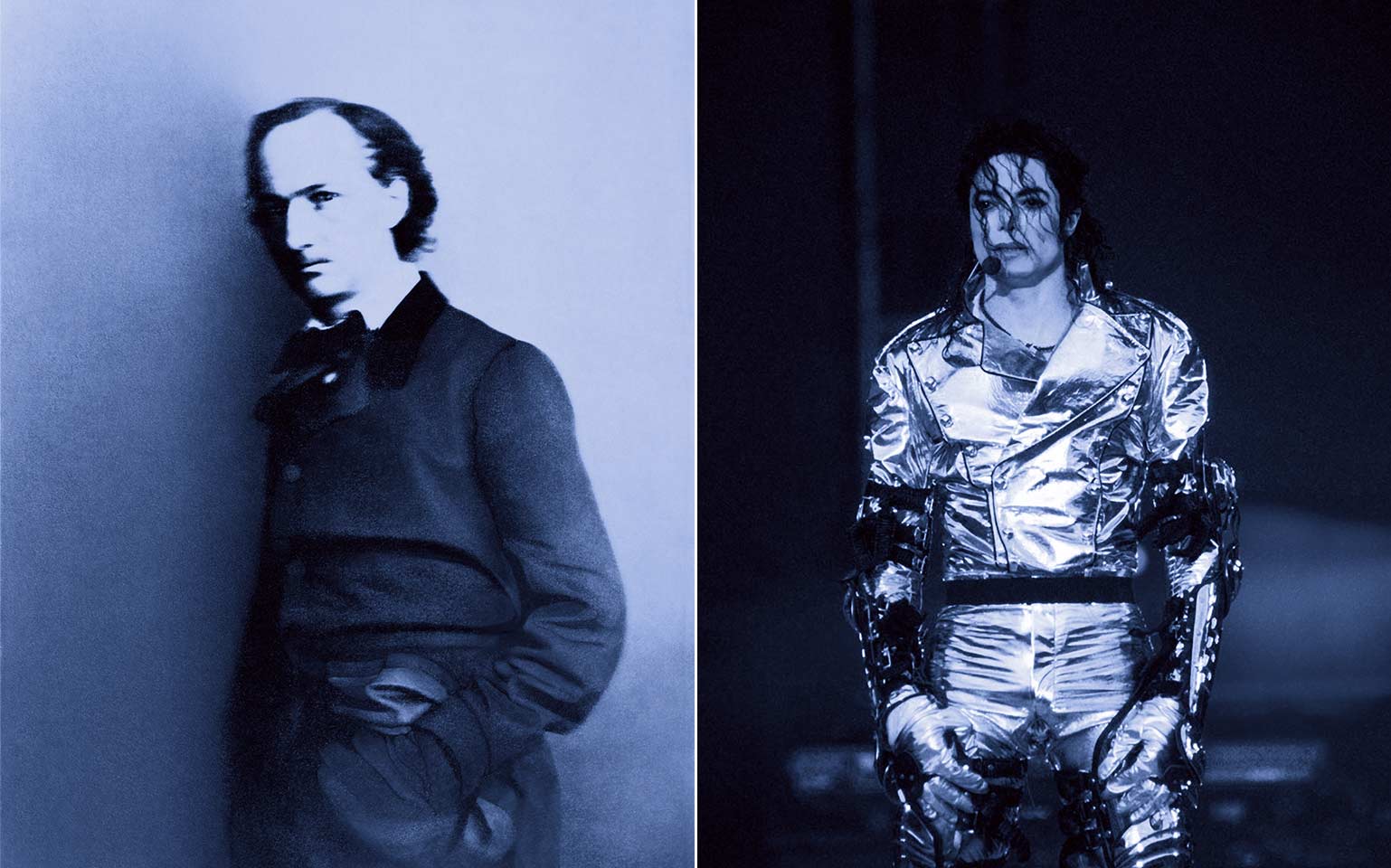
“Baudelaire’s Les Fleurs du mal (Flowers of Evil), published in 1857, was a turning-point for European poetry like that given painting 50 years later in Picasso’s Les Demoiselles d’Avignon. Each work embodies the psychologically complex ways modernism constructed itself out of Europe’s encounter with the worlds it colonized.”
“Seen in this way, Les Fleurs du mal is the more interesting: whereas the Demoiselles struggled to contain already mediated forms of art, Flowers was dealing with the body and psyche of a live and messy human being.”
“I am not so much interested in the literal Jeanne as in the figurative one—the hybrid woman caught up in the dilemmas of diaspora. We all are now from some other place, trying to orient ourselves, using and being used, struggling to gain a foothold.”
– Writing in Space, p. 31-32
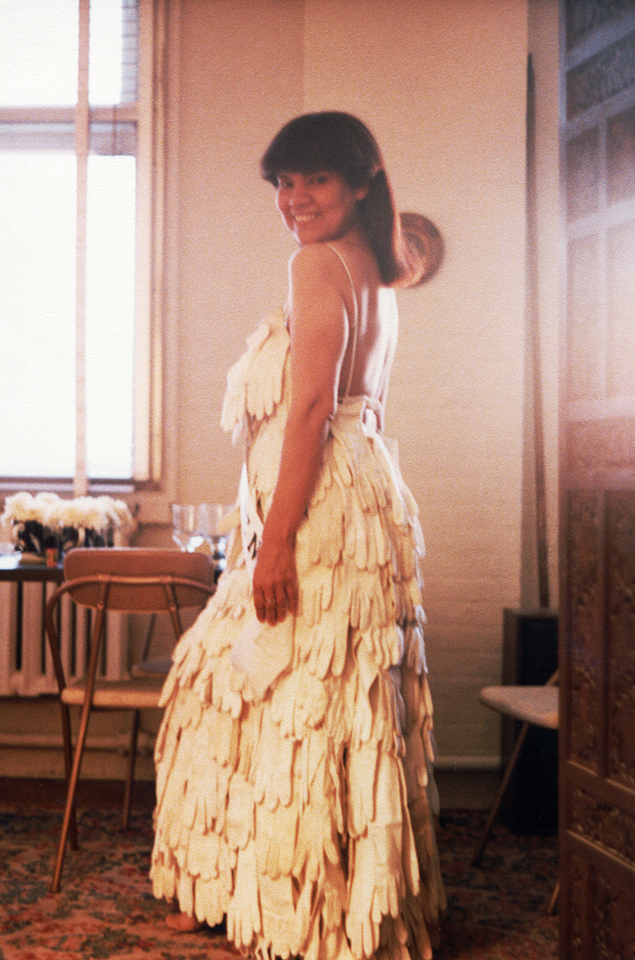
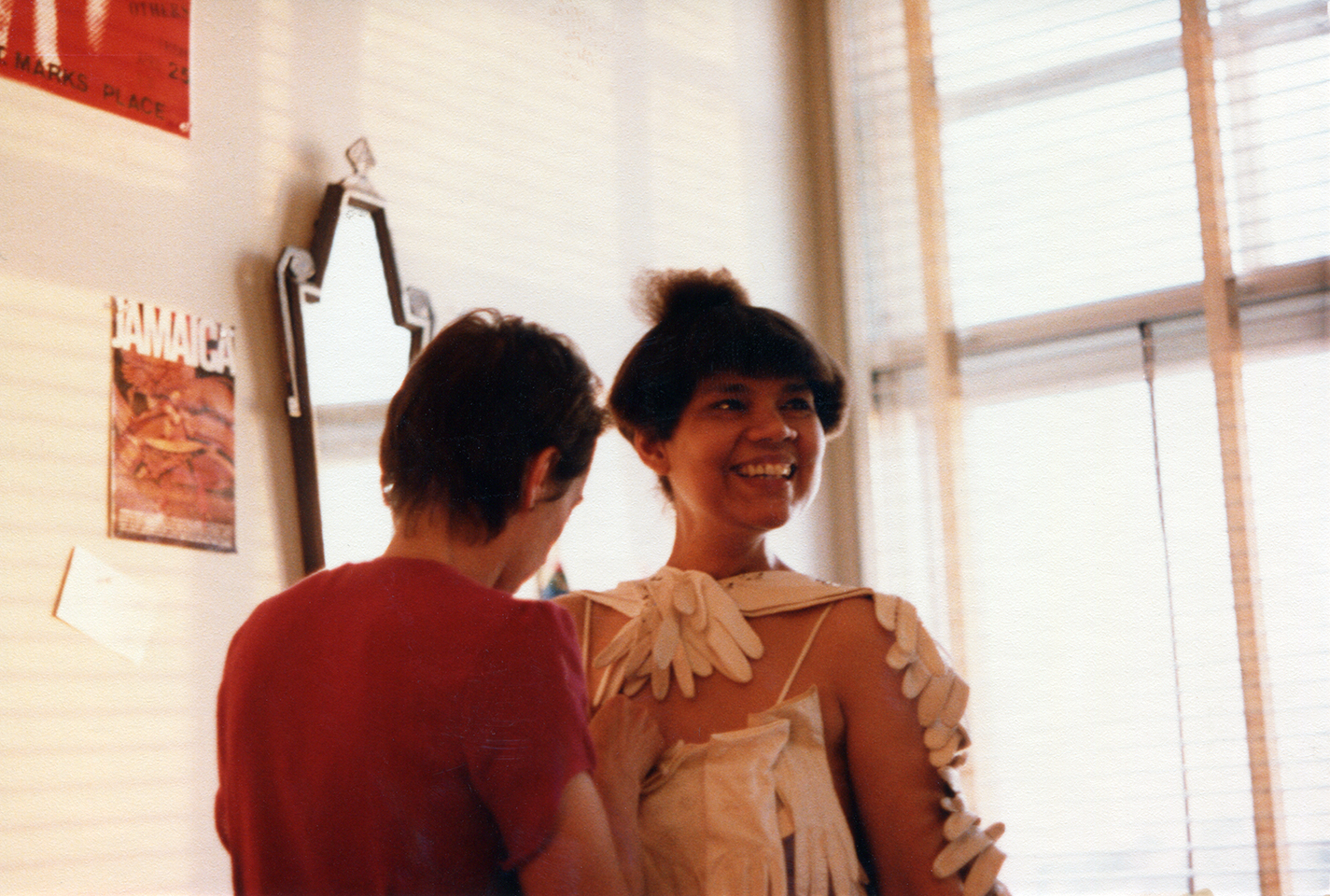
O’Grady preparing for a performance of Mlle Bourgeoise Noire at Just Above Midtown Gallery, New York, 1980.
From Performance Statement #2 (1982)
“The predominant aesthetic of my work is that of collage, i.e., of disparate realities colliding, of fragmentation and multiple points of view (I teach a course in Futurism, Dada and Surrealism at SVA) But with me, the collage aesthetic reflects a desire to unify and contain everything. It isn’t intended to be merely descriptive; it is never a capitulation to the fragmentation and division.”
“I undertake the quest for ‘wholeness’ and ‘meaning’ knowing that it’s doomed. But I can’t help harboring a secret hope that I will be able to achieve psychological and artistic unity.”
“The governing aim of my work is to undermine the concept of opposites.”
“I try to make work that is… both formally beautiful and capable of delivering specific intellectual and political content. [And I try] to find formal ways to combine an obsession with autobiography and the inner life of dream and myth with an attitude of political intransigence (you might say I am both a Jungian and a Marxist in my fashion).”
“I am aiming for the ‘perfect balance’ between personal and political, abstract and concrete, and whenever the work is too heavily weighted toward one or the other—which it most often is—I feel that I have failed. But I keep trying.”
– Writing in Space, p. 41
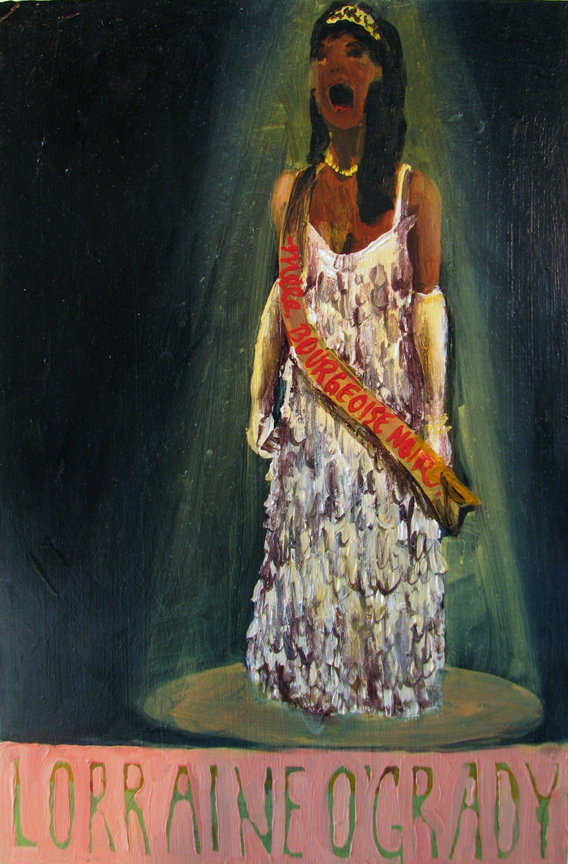
O’Grady as Mlle Bourgeoise Noire, painted by Kirsten McCrea for her Hot Topic series (2006–2008), inspired by the artists and feminist icons named in Le Tigre’s song of the same name. The series was on view at Galerie Maison Kasini in 2011.
From Performance Statement #3 (1983)
“If pressed to describe what I do, I’d say that I am writing in space.”
“[I was] trained as a writer (I went to the Iowa Writers Workshop, etc.). But I was never able to accommodate to the linearity of writing. Perhaps I’m too conscious of the stages I’ve lived through and the multiple personalities I contain. I think I’m also too aware of the interstices between consciousness and the unconscious.”
“The fact is, except for the lyric poem, writing is the art form most closely bound to time; but to layer information the way I perceived it, I needed the simultaneity I could only obtain in space.”
“I haven’t stopped writing or thinking literarily; but for now, performance is the way I write most effectively.”
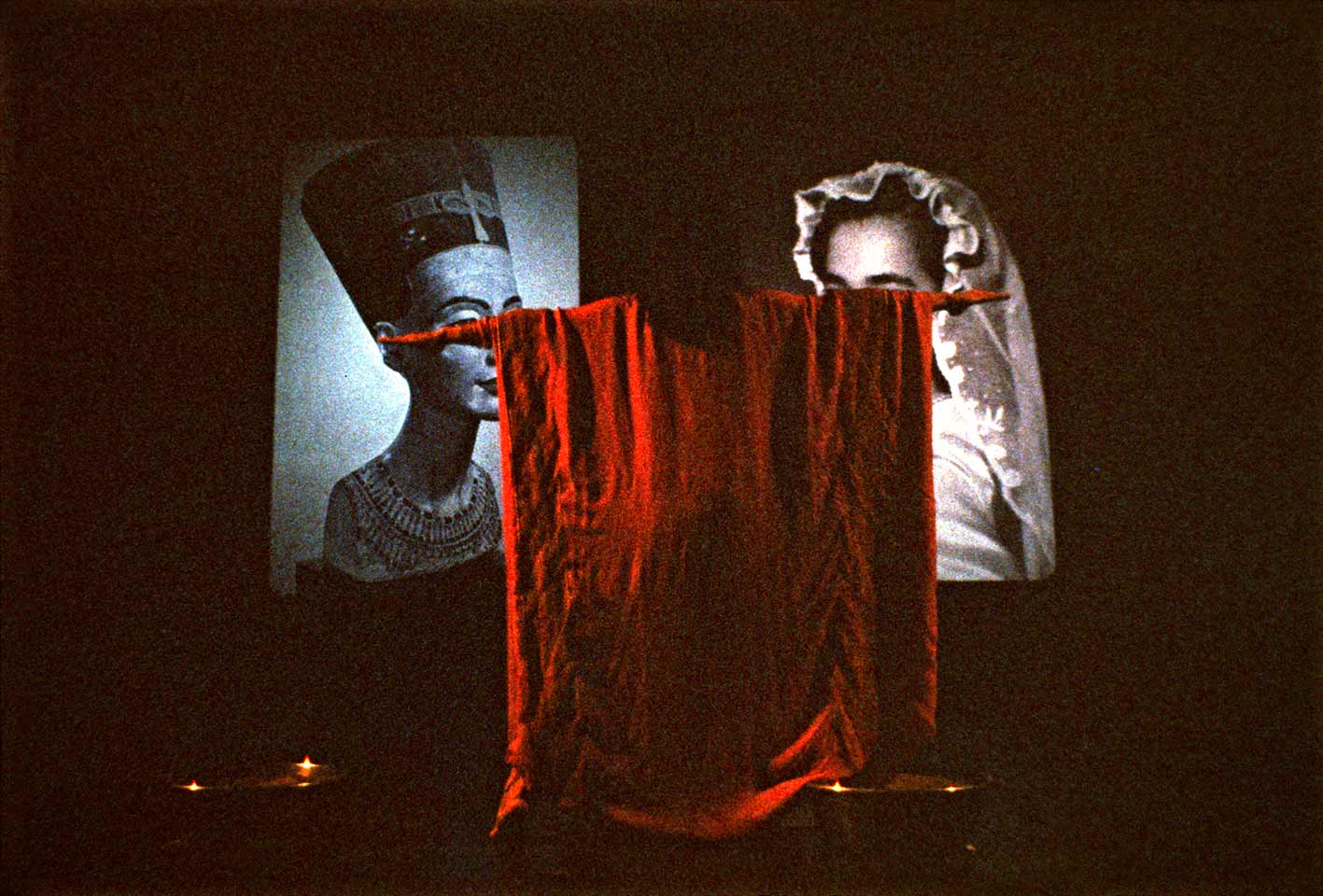
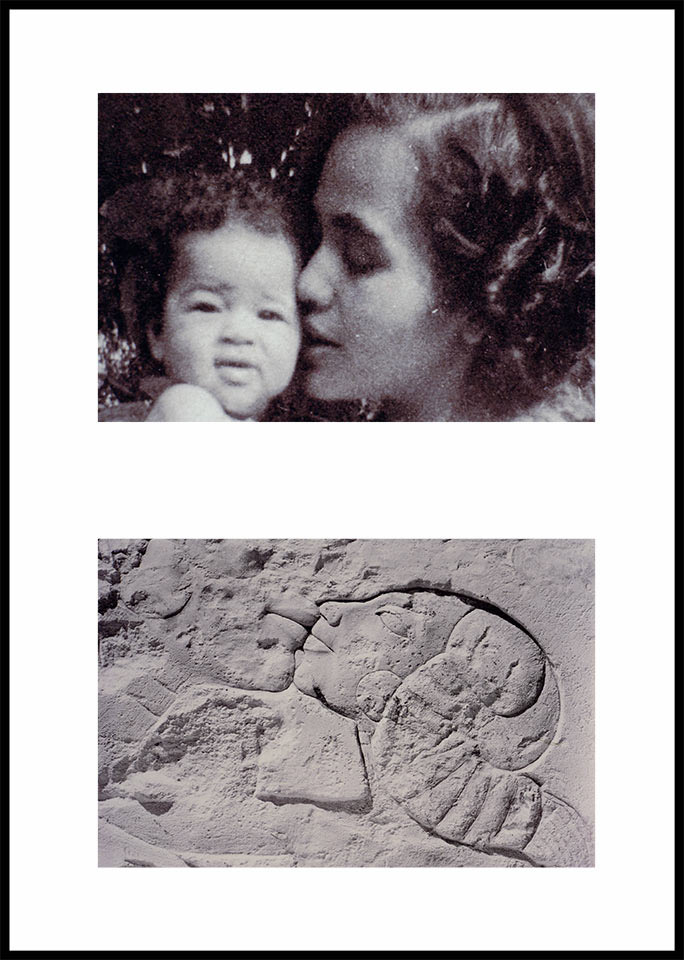
“To me, Mlle Bourgeoise Noire is actually a didactic essay written in space, while the form of Nefertiti/Devonia Evangeline approximates that of a book—a family photo album, interlaced with personal reminiscence and ritual.”
“‘Performance,’ as I conceive of it and as it most interests me, has nothing to do with a simple multiplication of media. In its most profound sense, ‘performance’ is a matter of artists shifting dimension, putting themselves at risk by changing their accustomed relation to space/time.”
“Visual artists, in venturing out from space-bound art forms into [performance and] the area of time, are as ill at ease and inept at dealing with sequentiality as a writer like myself is in handling space…. This is why I insist on calling my work ‘amateur.'”
“To me, ‘performance’ artists are explorers, primarily motivated by the sense of play. They leave to others the production of perfect artworks. At its best, ‘performance’ is dedicated to uncovering possibilities, to enlarging what is known about both old and still-unnamed art forms.”
“I’d like to discover new lands of narrative, lands whose shape I won’t be able to imagine until I get there. If there’s any time left, I’ll try to explore and map the territory.”
“Work can’t exist alone any more than the artist can.”
“There’s a wonderful passage in Heidegger where he speaks of the need for ‘preservers,’ that combination of presenters, critics, and audience required for the work to come into existence, into being, after it has been created by the artist. He describes that group’s function as ‘preserving the work, as knowing’ (my emphasis). I take that to mean that it’s a matter of who understands the work, who needs the work in order to be themselves.”
“Right now, my goal is to discover and create the true audience, and something tells me that, for a black performance artist of my ilk, this will take a many-sided approach.”
“Because I sense that the true audience may be coming, not here now, I try to document my work as carefully as I can. It may seem odd for a performance artist to be concerned with preservation of the work. But despite my devotion to the fluidity of performance, its privatistic and ephemeral aspects have never interested me much.”
“The work requires an audience who, whether or not they are like me, can see what I see.”
“Preservation at [the level of which Heidegger speaks] is difficult for any artist to find. Such standing within can only be achieved through the profoundest identification with the work: not just with its form, but with its content as well. And it’s precisely this sort of identification that is hardest for the avant-garde black artist to come by. For one can only succeed in knowing at this depth if one is seeking to know his/her self.”
“I don’t take this as a permanently limiting condition of the work. The problem as I see it is simply that, so far, the context of black art hasn’t been [broadly enough established] for either whites or blacks to become so familiar with it that they can cross the barriers of race and sex to seek themselves—the way anyone can in a Jewish novel, for instance, or even in a Merce Cunningham dance concert. But already this is beginning to change.”
“The idea of 11 to 13 of the best black performance artists in America being presented at one time, of a context finally being established, makes it possible to imagine a day when we can stop being unique and simply concentrate on doing our work. A day when, finally, the ‘preservers’ will no longer be ‘coming’ but will already be there.”
– Writing in Space, p. 43-48
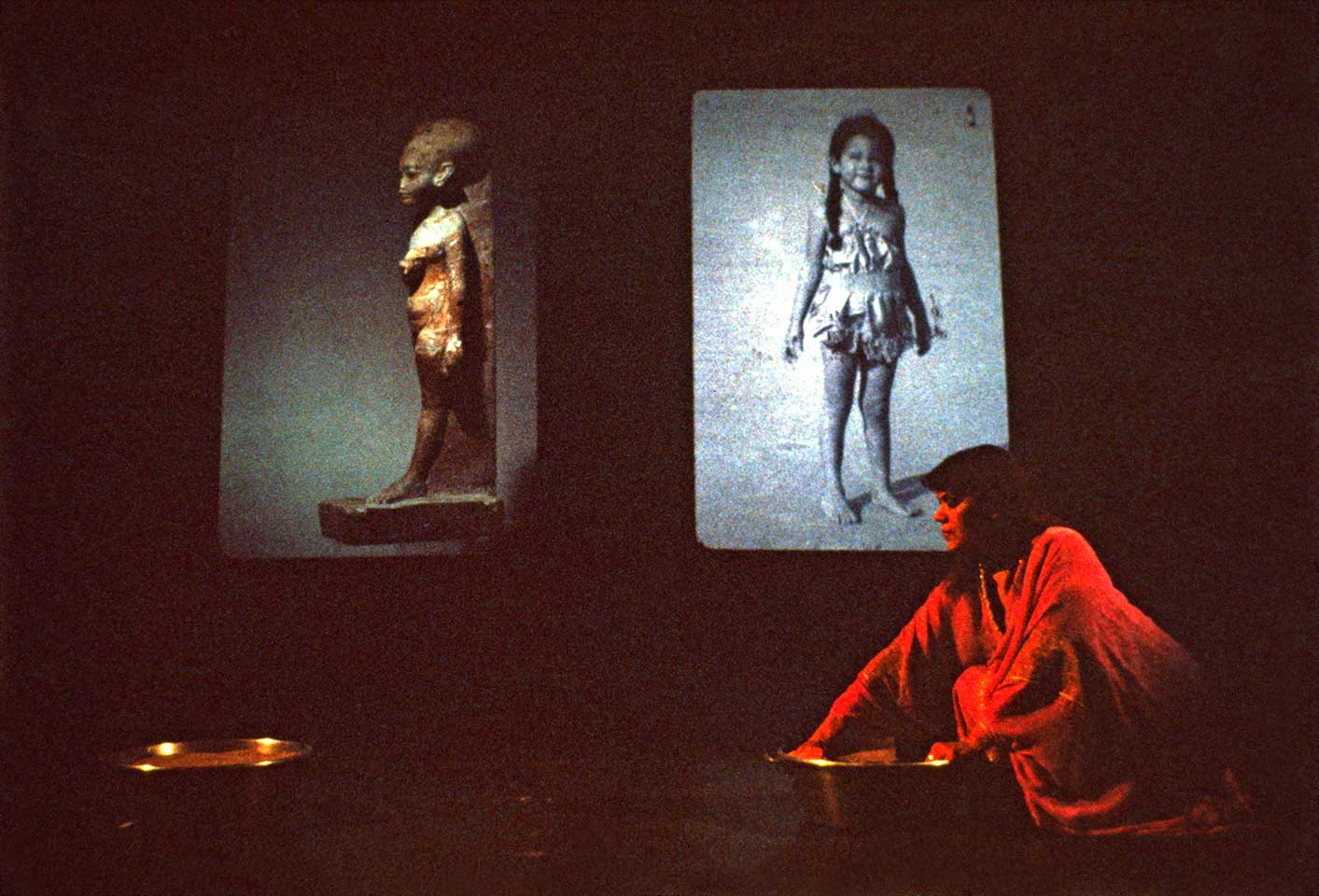
O’Grady performing Nefertiti/Devonia Evangeline, 1980. “Told to swing an incense censer, she stirs sand instead.”
From Nefertiti/Devonia Evangeline (1997)
“In 1980, when I first began performing, I was a purist—or perhaps I was simply naive. My performance ideal at that time was ‘hit-and-run,’ the guerilla-like disruption of an event-in-progress, an electric jolt that would bring a strong response, positive or negative… as the initiator, I was free: I did not have an ‘audience’ to please.”
“The performance ethos of the time was equally naive: entertaining the audience was not a primary concern. After all, wasn’t it about contributing to the dialogue of art and not about building a career? I prepared Nefertiti/Devonia Evangeline in expectation of a one-night stand before about fifty cognoscenti and friends. It was a chance to experiment and explore.”
“In Cairo in my twenties, I found myself surrounded for the first time by people who looked like me. This is something most people may take for granted, but it hadn’t happened to me growing up in the 1940s in ‘virtually’ all-white Boston or visiting my godparents in ‘virtually’ all-black Harlem.”
“Performance’s advantage over fiction was its ability to combine linear storytelling with nonlinear visuals. You could make narratives in space as well as in time, and that was a boon for the story I had to tell.”
“I will always be grateful to performance for providing me the freedom and safety to work through my ideas; I had the advantage of being able to look forward, instead of glancing over my shoulder at the audience, the critics, or even art history.”
“Rather than traducing the original performance idea, Miscegenated Family Album seemed to carry it to a new and inevitable form, one that I call ‘spatial narrative.'”
“[Miscegenated Family Album] is a total experience. But whenever diptychs are shown or reproduced [individually], as they often must be, it is difficult to maintain and convey the narrative or performance idea. As someone whom performance permitted to become a writer in space, that feels like a loss to me.”
– Writing in Space, p. 50-52
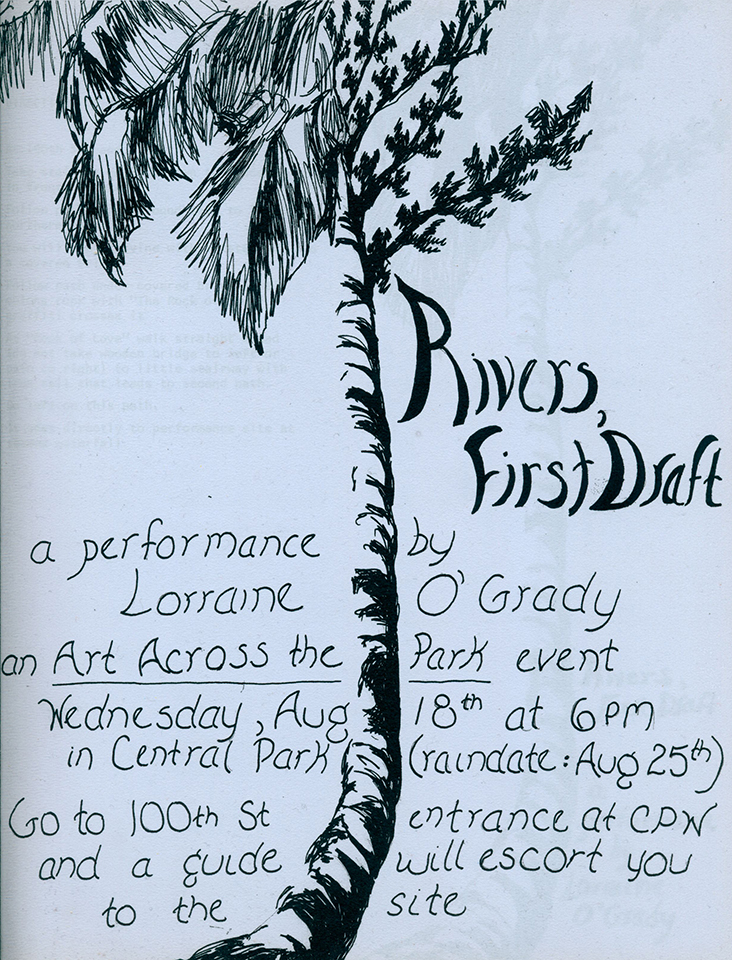
Performance script for Rivers, First Draft, a one-time-only performance created by Lorraine O’Grady for Art Across the Park, curated by Gilbert Coker and Horace Brockington.
From Interview with Cecilia Alemani (2010)
“I taught a course for nearly two decades here at SVA in which we read just two books, Baudelaire’s Flowers of Evil and Rimbaud’s Illuminations. It was crazy. Each year, I never knew which I would prefer, whose book I would teach better. It’s a generalization, of course, but on balance Charles and Arthur seemed to divide two halves of the human mind, the impressionist and the expressionist, the dada and the surrealist if you will, and I never knew which half of my own mind would dominate when I encountered them.”
“In the period of romanticism, it had been so easy to see God in the daffodils, in babbling brooks that ran through the trees. It was still easy even for the artist in cities to view himself as a servant, making art in God’s image. But now the city had changed. One had to see God and beauty in homelessness, in the oil slick on a mud puddle, in the noise and greed. And Charles was one of the first who could do this.”
“I suppose you might say that the modernist moment was the first time art had to be made without God, without guideposts. We’d soon see even the alternative to God, rationalist intellect, being discarded as an incomplete tool.”
“Soon I began to see these two aspects of Charles, the relationship with Jeanne [Duval] and the meeting of modernism’s challenges, as somehow connected… It seemed to me that the insider-outsider position he occupied with her, while not a cause, enabled, perhaps made inevitable the completeness of his transition to modernism.”
“It may seem odd, but for me as an artist, theory freed the imagination…. The Birmingham school of cultural theory, Stuart Hall and others … shed new light on [the world of Jeanne and Charles] and helped me to feel what it was like. When that happened, things were turned on their head. If most definitions of postmodernism, however contested, contain elements of globalization, diasporic movement of peoples, hybridity of cultures, and increasing gender equality, then while Charles was waging his valiant struggle with modernism, Jeanne was already living a postmodern life. She was closer to me and to current generations than she had been to Charles!”
“Imagining Jeanne in turn helped me imagine Lena [my mother]… It was a shock when I first saw Charles married to Lena that way. But it explained a lot about why Charles and Jeanne had been together so long. I could see that she had led him a merry chase!”
“While the old dichotomies between white and black cultures, and between entertainment and fine art, are understandable—it’s hard to live on both sides simultaneously—the hierarchies between these imagined oppositions seem not just passé but fundamentally untrue.”
“The first of the new is always the last of something else. Charles was both the first of the modernists and the last of the romantics. He was bound to live forever in the forest of symbols. And Michael [Jackson] may have been the last of the modernists (no one can ever aspire to greatness that unironically again), but he was also the first of the postmodernists.”
“When I replaced Jeanne and Lena with Michael and put the two men on the wall, I couldn’t decide whether they should be seen more as lovers or as brothers.”
– Writing in Space, p. 53-59
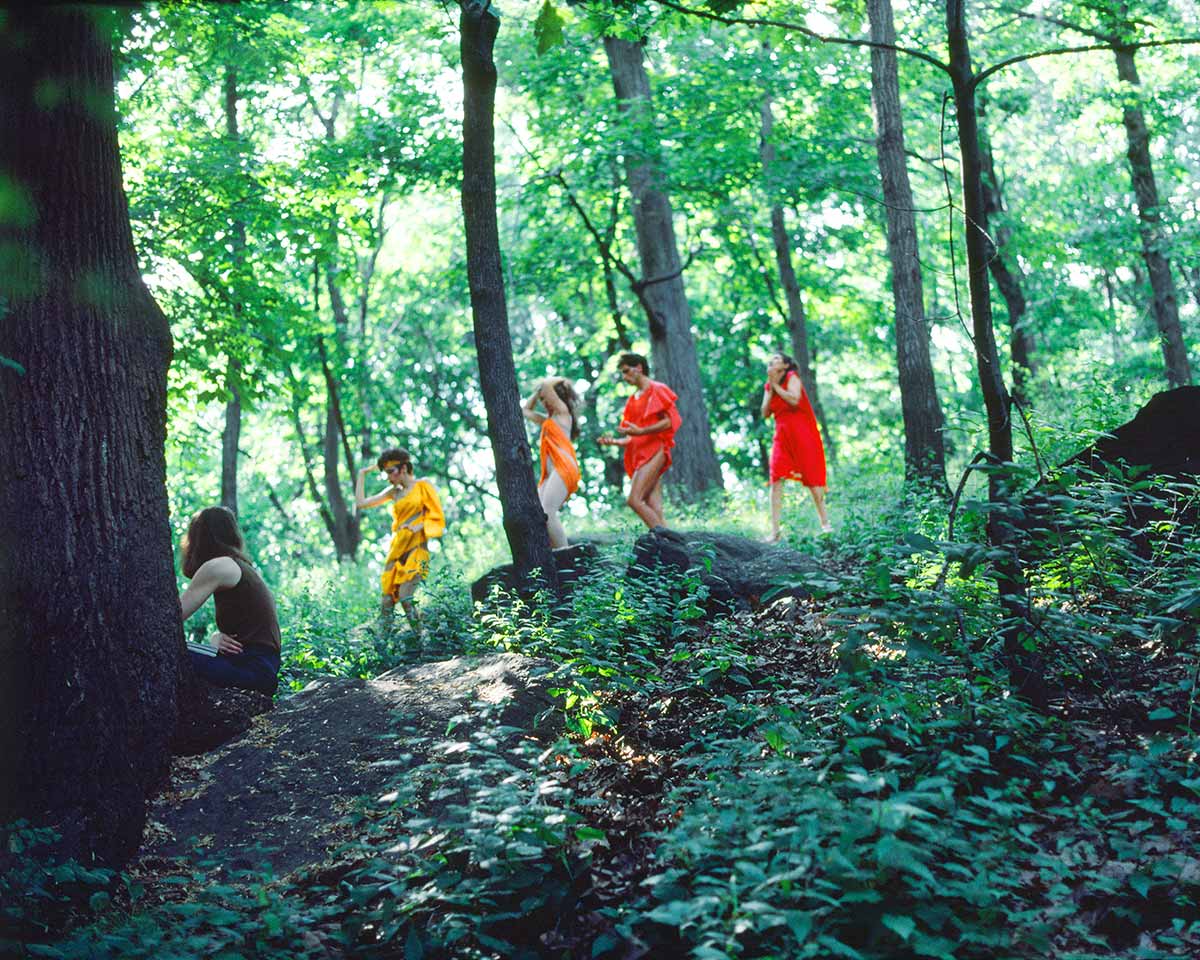
Rivers, First Draft, The Debauchees dance to New Wave music with the Woman in Red following, 1982.
From Interview with Amanda Hunt on Art Is… (2015)
“What I learned in the process of the parade is that a parade is not a continuous motion. In a parade there are moments when you are just standing still and not getting anywhere, and then there are moments you are rushing to catch up. To me, a film was going on behind that big frame, like a moving proscenium on the float. But as if it were in an old Moviola editing machine… it started and stopped… started and stopped.”
– Writing in Space, p. 62
From On Creating a Counter-Confessional Poetry (2018)
“The form of my work has proven to me to be more important than the content. If you had told me when I started forty years ago that I would be saying that, I would probably have laughed. But the diptych has always been, in a sense, my primary form, even in the performances.”
“For me, the diptych can only be both/and.”
“When you put two things that are related and yet totally dissimilar in a position of equality on the wall, for example, they set up a conversation that is never-ending. It’s a totally unresolvable, circular conversation. And I think that that ‘both/and’ lack of resolution—the acceptance and embrace of it, as opposed to the Western ‘either/or’ binary, which is always exclusive and hierarchical—needs to become the cultural goal.”
“The diptych, which is actually anti-dualistic, has served me to make the point against ‘either one, or the other.'”
“While I understood [the need of the Dadas and the Surrealists to surrender to the random after World War I had proven European rationalism to be a lie], that could never ever interest me as a goal, since I’d always felt the culture I was immersed in was completely irrational. My trajectory instead was not to surrender but to try to conquer the random, to wrest some rationality from the irrationality that so many ‘others’ to the normative culture have to live with.”
“When I hit the New York art world in the early 1980s, it was a shock to my system. Not only was it segregated between races—it was also segregated along lines that were so subjective there was no logical countering of them.”
“Everywhere I’d been in the world up to that point there had at least been [somewhat] objective measurements of my accomplishments, from SATs to exams for federal service. The year I graduated from college, out of 20,000 who took the Management Intern Exam I was one of 200, and the first girl from Wellesley, to pass. I didn’t have to prove myself. And later, when I became a translator, I mean, either you could translate accurately or you couldn’t.”
“So when you come into the art world and you see a totalized worldview that is quite provincial, because it’s isolated everything but itself, and that’s what’s telling you that you are derivative—that you are not interesting—well, it seemed a little out of line with reality. But now I think it was more like a dislocation from reality, an exaggeration of the irrationality that, as a woman of color, I had experienced all along.”
What I found in surrealist language was the obverse of what the Surrealists had found: it enabled me not to surrender to the random, but to control it. That’s why I did Cutting Out the New York Times (CONYT) in 1977. I wanted to see if I could take the public language of the New York Times and make it personal. And unlike the confessional poets of the time who confessed from the inside out, I wanted to see if I could create a ‘counter-confessional’ poetry that could ‘confess’ from the outside in.”
“In 2017, forty years later, I felt an urgent need to reconnect to the voice of that 1977 piece….The shock of entering the art world in 1980 had caused a distortion in what I produced it seemed, away from the more experiential and toward the more argumentative. I wanted to get back to that earlier voice so as to get on with new work.”
“I called the show at the Savannah College of Art and Design From Me to Them to Me Again to signal a return. But now I think that was the wrong title. I should have called it From Me to Them to We Again. Because creating these totally new haiku-like objects in Cutting Out CONYT had not only illuminated the role of the diptych in my personal work, it had given me a glimpse into what might be my contribution to culture as a whole.”
– Writing in Space, p. 64-66
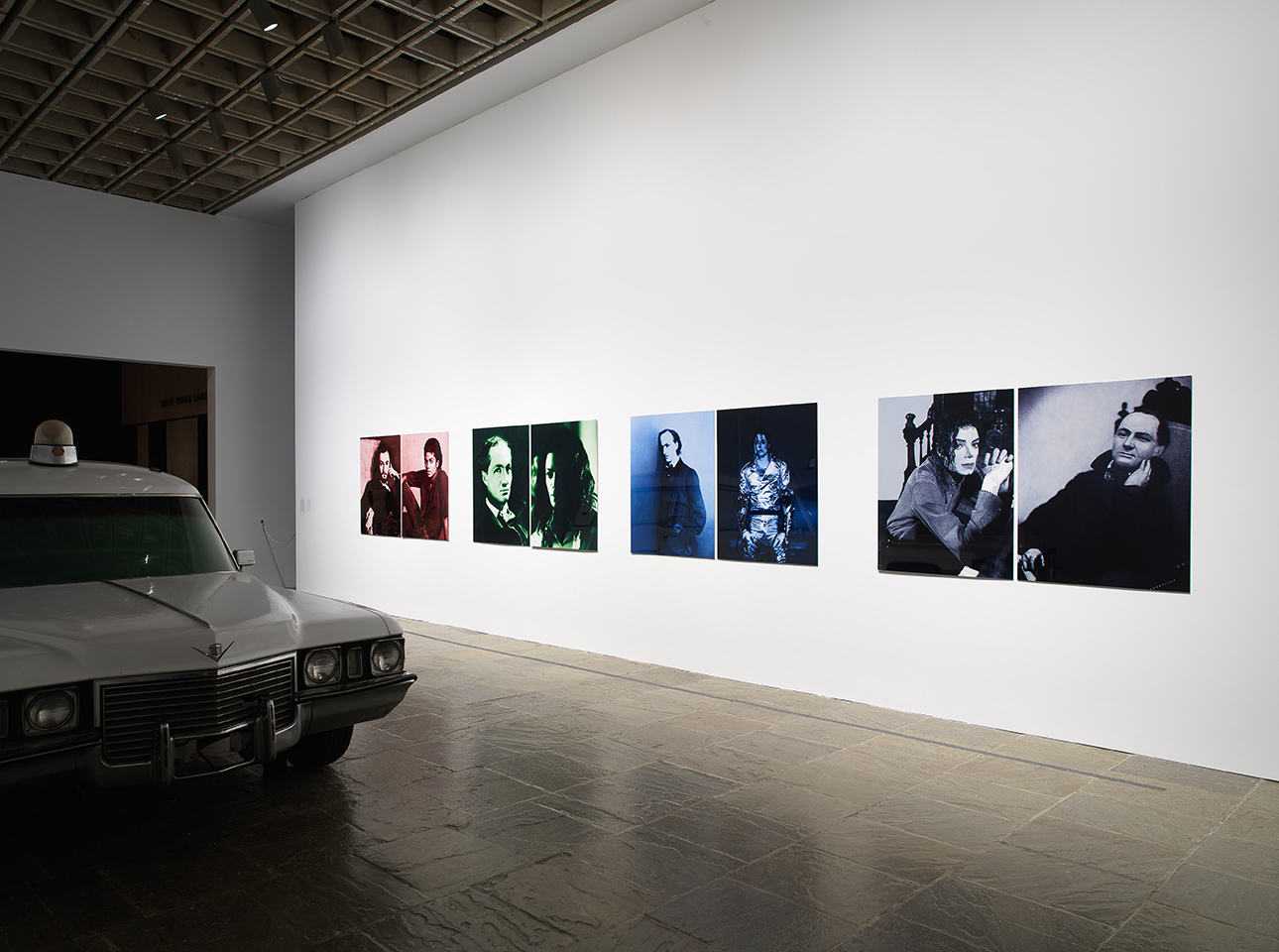
The First and the Last of the Modernists at the 2010 Whitney Biennial. Photograph by Sheldan C. Collins.
From Black Dreams (1982)
“On Thursday, August 20, 1981, I was feeling depressed about Reagan, and paranoid about the fascism lying in wait just below the surface of the country. In my worst-case fantasies, the dragon breaks out and, as in Nazi Germany, gobbles up those closest at hand: assimilated blacks first. That afternoon I wrote in my art journal a proposal for an installation to be called ‘Walter Benjamin Memorial Piece (A Black Intellectual Gets Ready In Time’ [to be a talisman against having to kill myself at the Franco-Spanish border].”
– Writing in Space, p. 70
From Interview with Linda Montano (1986)
“When I was born, my mother was thirty-[six] and my only sister was eleven. I guess I came along just when my mother was imagining she was about to become free, and the feeling that I was an afterthought, that I wasn’t really wanted, was somehow always conveyed to me.”
“Because I was unhappy in my family… I began very early to reject the rituals offered me and to think up others.”
“I think I unconsciously began to search out rituals that wouldn’t interest my family at all… like going to church…. My parents were generically Episcopalian because they were middle-class British West Indians [but] they never went to church, except for funerals and weddings. They thought all that kind of socializing was too simple, even lower-class. Perhaps I did, too, because that wasn’t the part of church that attracted me. What I liked were the rituals and the idea of belief in God.”
“While everyone else hung around the house on Sundays, I sought out the most ritualized Episcopal church I could find in Boston, not the West Indian parish, which was very Protestant and low church, but one that was so high church as to be almost indistinguishable from Catholic.”
“By late adolescence, the rituals had less to do with things like family and church and more to do with the outside world. At sixteen there was the birthday party. I didn’t want a birthday party. I wanted a formal sit-down dinner. That Spring there was the cotillion. The two most prestigious black social clubs each sponsored an annual cotillion, and both invited me…. I seemed to be the only girl from that social set who didn’t come out that year. At college, the expected bids to join the two nationwide black sororities, Alpha Kappa Alpha and Delta Sigma Theta, came in. Even though my sister had been president of the Boston chapter of [AKA]… I refused to have anything to do with that sort of thing.”
“The irony is, here I’d refused the cotillion, refused the sorority, but when I created Mlle Bourgeoise Noire, a satirical international beauty pageant winner with a gown and cape made of one hundred eighty pairs of white gloves, she was described by critics as a debutante.”
“I guess I was doing those rituals in my own way in my art later on, but distanced, as anti-rituals. They have nothing to do with nostalgia or an acknowledged longing but are more modes of attack than of participation. But who knows? They could be a longing that doesn’t know it’s own name!”
– Writing in Space, p. 77-79
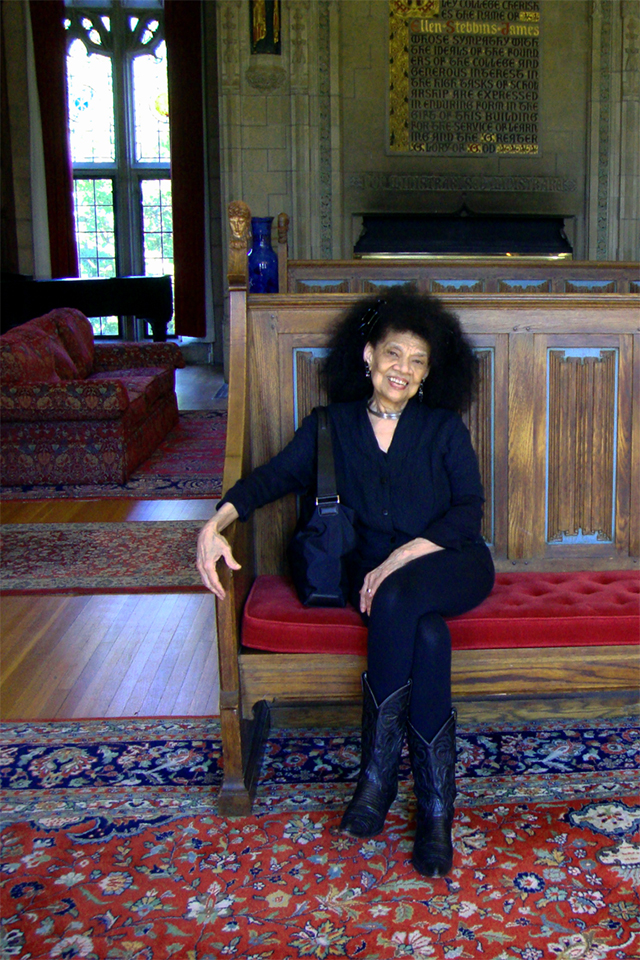
O’Grady in the Tower Court Living Room at Wellesley College, 2012.
From Dada Meets Mama (1992)
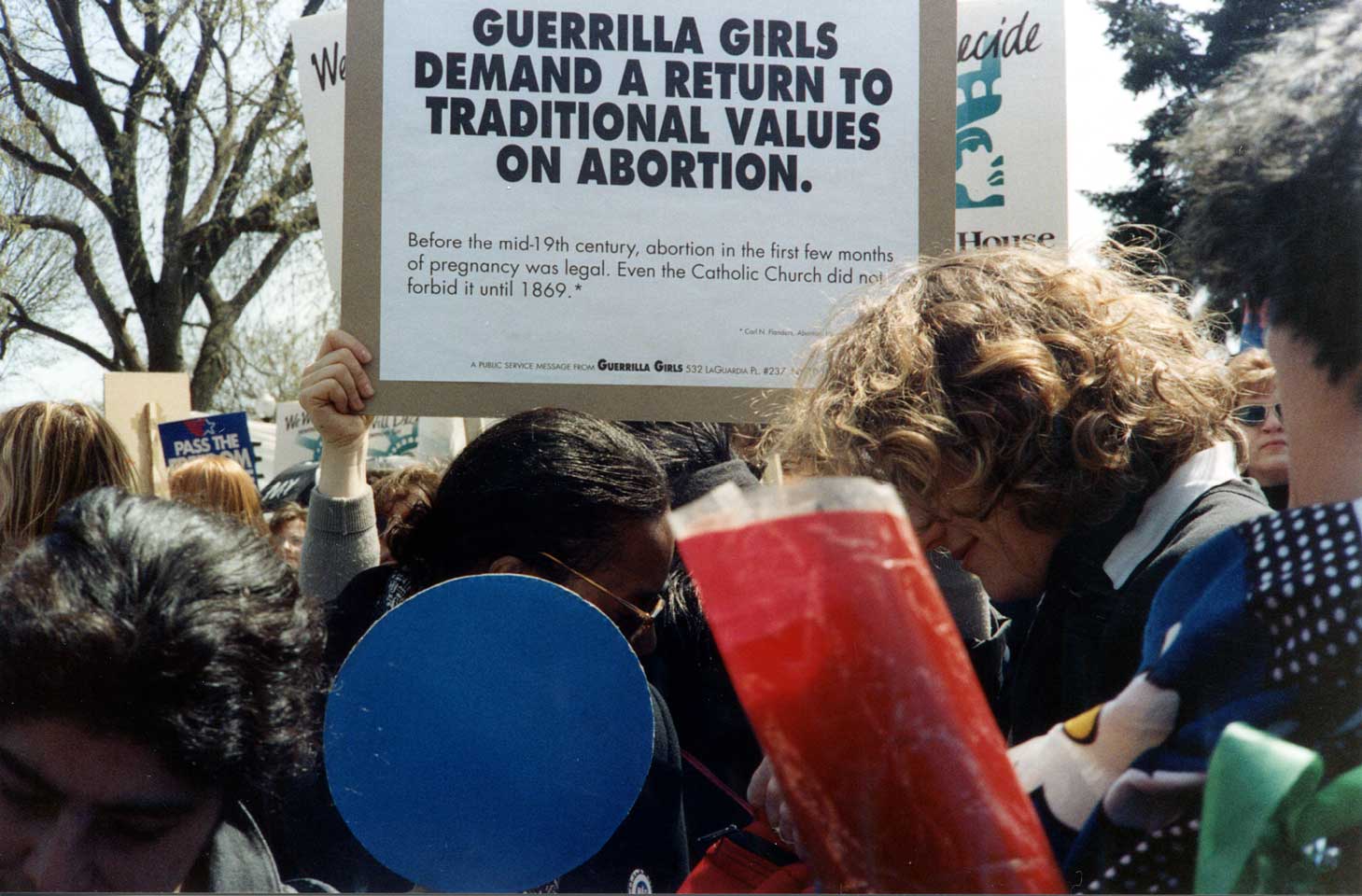
“Today, again, it feels like a World War I moment, what with a breakdown in bourgeois certainties and the new order nowhere in sight. The world seems cut deep with trenches out of which heads pop only to be shot off by mortars from the opposing side. That Dada arose then, and WAC [the Women’s Action Coalition] now, proves that the sleep of reason produces not only monsters but millenarian dreams of bliss.”
“In its earliest planning stages, WAC made a decision not to deal with difference head-on, not to risk discussions that might impede getting the job done. It may have started so white that it cannot now recover. At a philosophy meeting in late March, one young woman stunned the room by saying, ‘I don’t think WAC is too white, or too anything. I didn’t come for the women. I didn’t come for the coalition. I came for the action!’ It’s a statement that as the months have passed has come to seem more and more central. Even WAC’s bias against analysis seems to support it. [But if] you don’t want to talk, read, think, then nothing will change, and white women will maintain their privilege within the movement of determining what and where the action is.”
– Writing in Space, p. 84-86
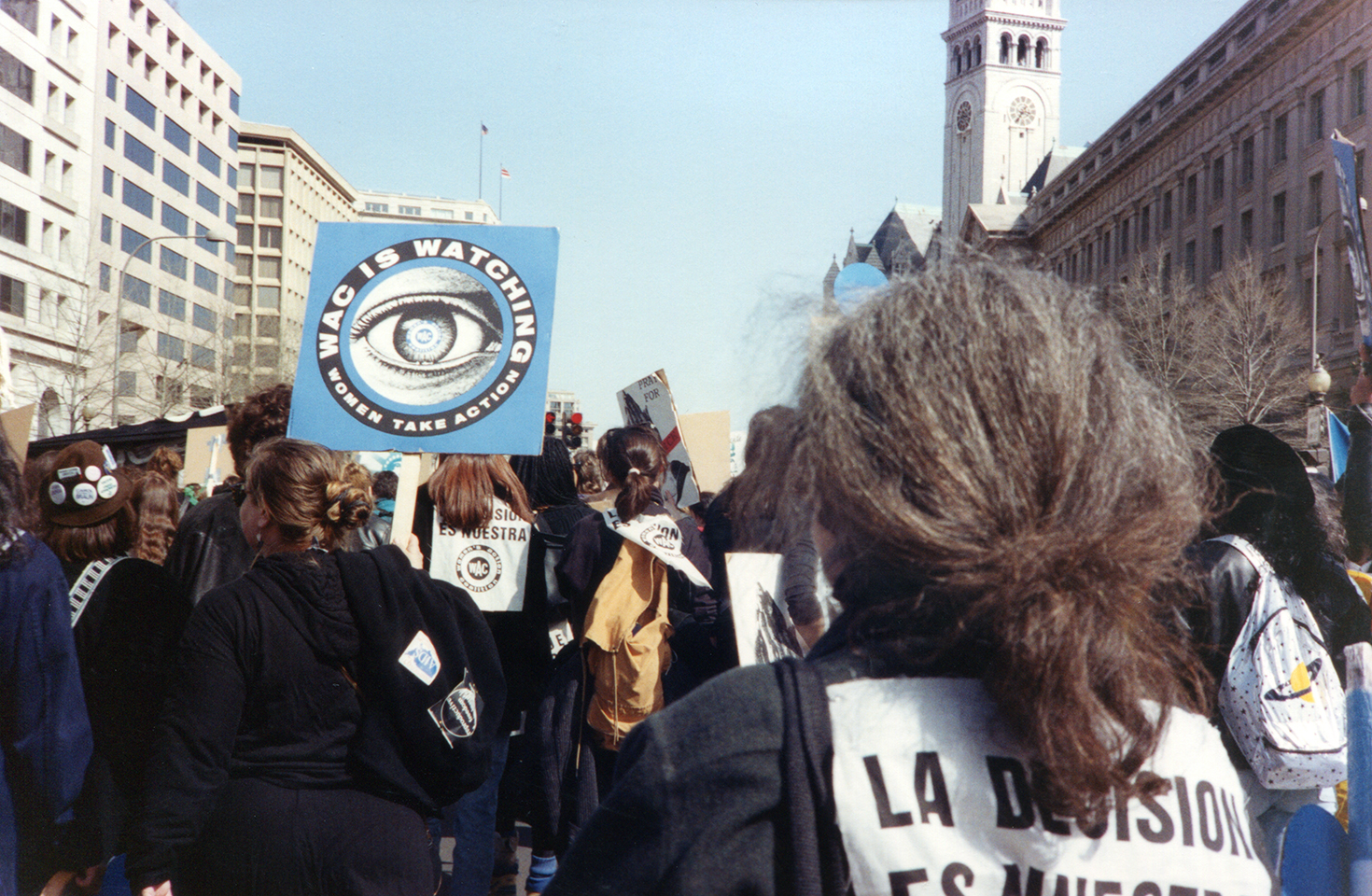
Women’s Action Coalition (WAC) contingent, pro-choice March on Washington in 1992. Photograph by Lorraine O’Grady.
From The Cave (1992)
“The invisibility of black women has been much on my mind of late. Asked recently to speak on the topic ‘Can women artists take back the nude from a voyeuristic male gaze as a site to represent their own subjectivity?,’ I have to discard the premise: from mass culture to high culture, white women may have been objects of the fetishizing gaze, but black women have had only the blank stare. In fact, we feel lucky when we get to take our clothes off.”
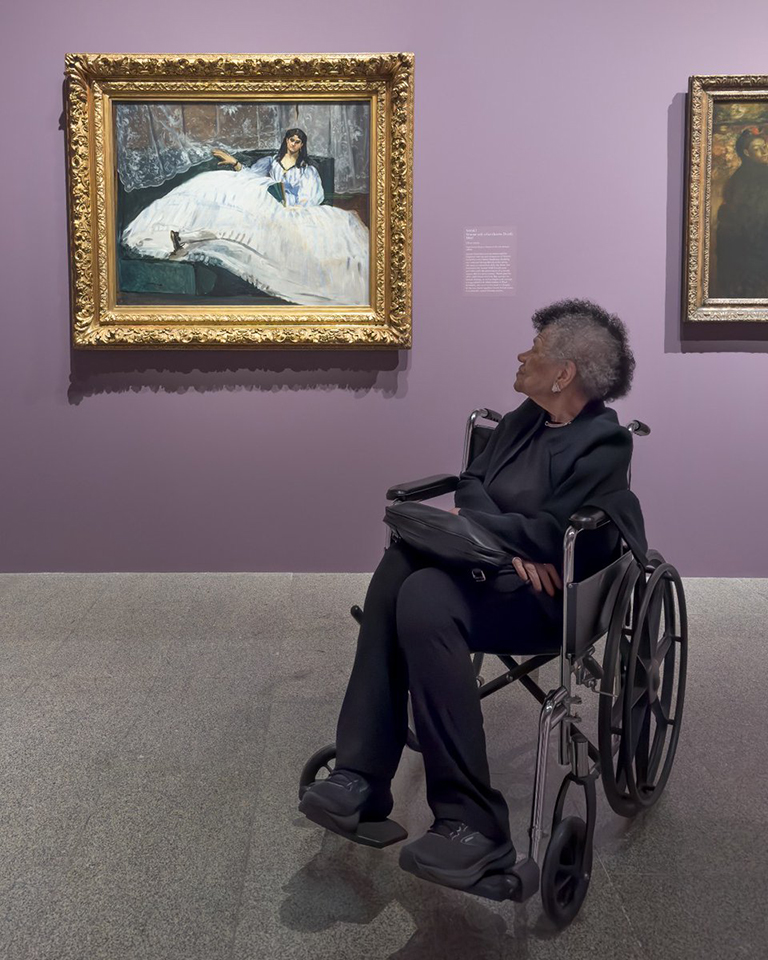
“Manet’s Olympia [1863], Picasso’s Demoiselles d’Avignon [1907], and Judy Chicago’s Dinner Party [1973-78] are landmarks in our unseeing erasure by both the multi-colored male and the white female.”
“Of the thirty-nine places at Chicago’s table, thirty-five are set with plates painted with vaginas that glow miraculously. Sojourner Truth, the only black guest, must make it without a pussy. She alone has a face; and not one but three: one screaming, one smiling, and one weeping a clichéd tear. And Manet’s Laure, fully dressed behind the nude and oh so white Olympia, is two-in-one: she is Jezebel united with Mammy, the whore combined with the female eunuch, who can only escape from an undialectical fate by disappearing into the background drapery.”
“The trouble with being erased for so long is that you come to think of your erasure as natural—until the moment when something, a novel by Toni Morrison, an essay by Hortense Spillers, an artwork by Adrian Piper, pierces your invisibility to yourself and becomes real. [Euzhan] Palcy’s Sugar Cane Alley, from France by way of Martinique, was my first glimpse of even a portion of my own peculiar African-Antillean-European-American sensibility on screen.”
“Certainly if our subjugated knowledges were to become primary, we would change the world. Imagine what would happen if we were to refuse banishment to the unnameable chaos that defines what woman is not. If we were to claim our stereotypes and make Jezebel the sign of our acceptance of our own bodies, Mammy the symbol of our ability to nurture, and Sapphire the signifier of our resilience and strength. If we could share and build on what we’ve learned about ourselves and others from an exploitative work world. At the very least we would, as Spillers suggests, write a whole new text for female empowerment. But even more dismaying to ‘them’ might be our self-involvement, the discovery that we and not they are the center of our universes.”
– Writing in Space, p. 89-91
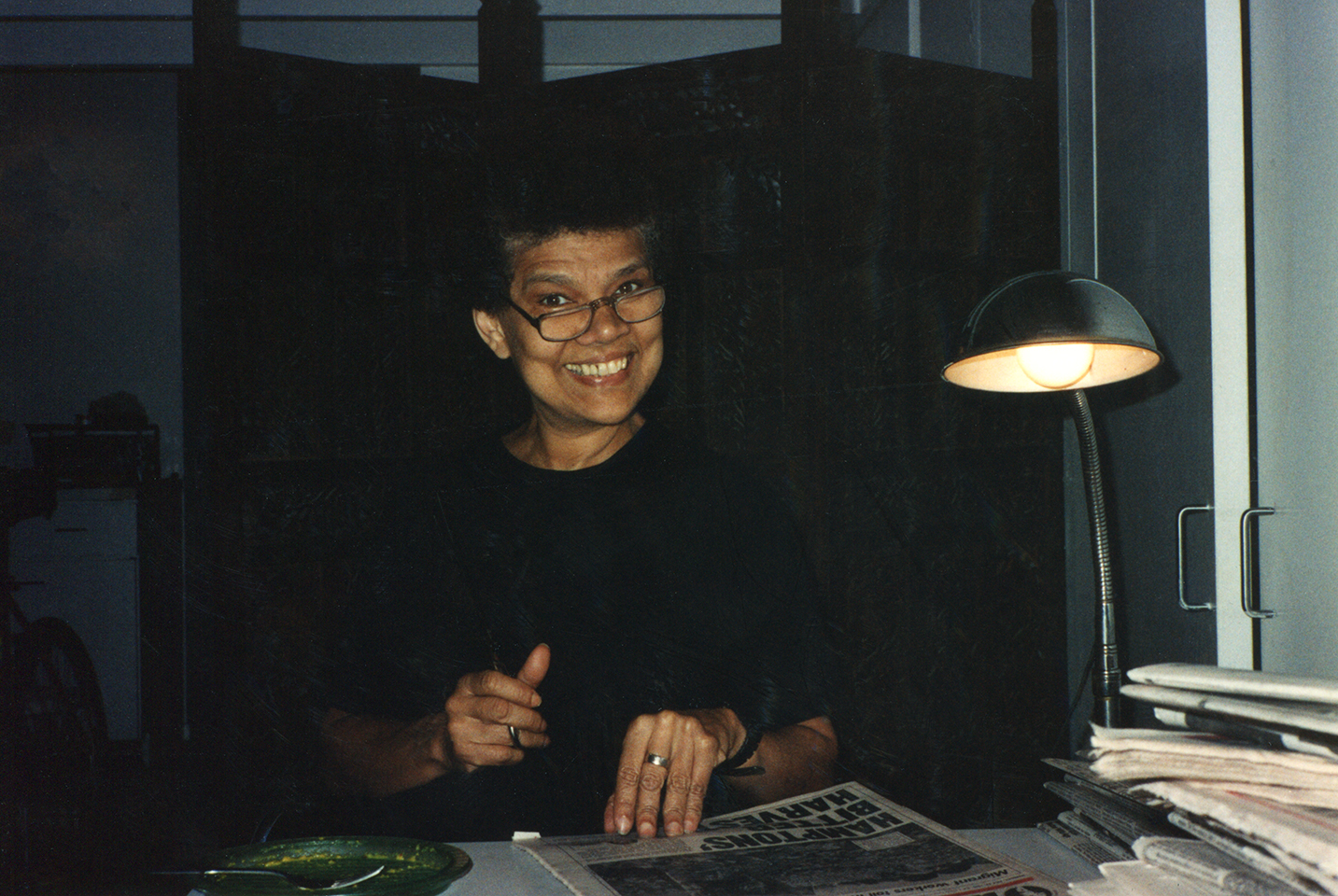
O’Grady working in the 1990s. Photograph by Robert Ransick.
From Olympia’s Maid (1992/1994)
“To name ourselves rather than be named we must first see ourselves. For some of us this will not be easy. So long unmirrored in our true selves, we may have forgotten how we look. Nevertheless, we can’t theorize in a void, we must have evidence. And we—I speak only for black women here—have barely begun to articulate our life experience.”
“The idea bears repeating: self-expression is not a stage that can be bypassed. It is a discrete moment that must precede or occur simultaneously with the deconstructive act.”
“For if the female body in the West is obverse and reverse, it will not be seen in its integrity—neither side will know itself—until the not-white body has mirrored herself fully.”
“The black female’s body needs less to be rescued from the masculine ‘gaze’ than to be sprung from a historic script surrounding her with signification while at the same time, and not paradoxically, it erases her completely.”
“Binaristic thought persists even in those contemporary disciplines to which black artists and theoreticians must look for allies. Whatever the theory of the moment, before we have had a chance to speak, we have always already been spoken and our bodies placed at the binary extreme, that is to say, on the ‘other’ side of the colon.”
“If artists and theorists of color were to develop and sustain our critical flexibility, we could cause a permanent interruption in Western ‘either: or-ism.”
“I’m convinced that important, perhaps even the deepest, knowledge comes to me through movement, and that the opposition of materialism to idealism is just another of the West’s binarial theorems.”
“My own concern as an artist is to reclaim black female subjectivity so as to “de-haunt” historic scripts and establish worldly agency. Subjectivity for me will always be a social and not merely a spiritual quest.”
“And if, as I believe, the most vital inheritance of contemporary art is a system for uncovering the unexpected, then programmatic art of any kind would be an oxymoron.”
– Writing in Space, p. 94-109
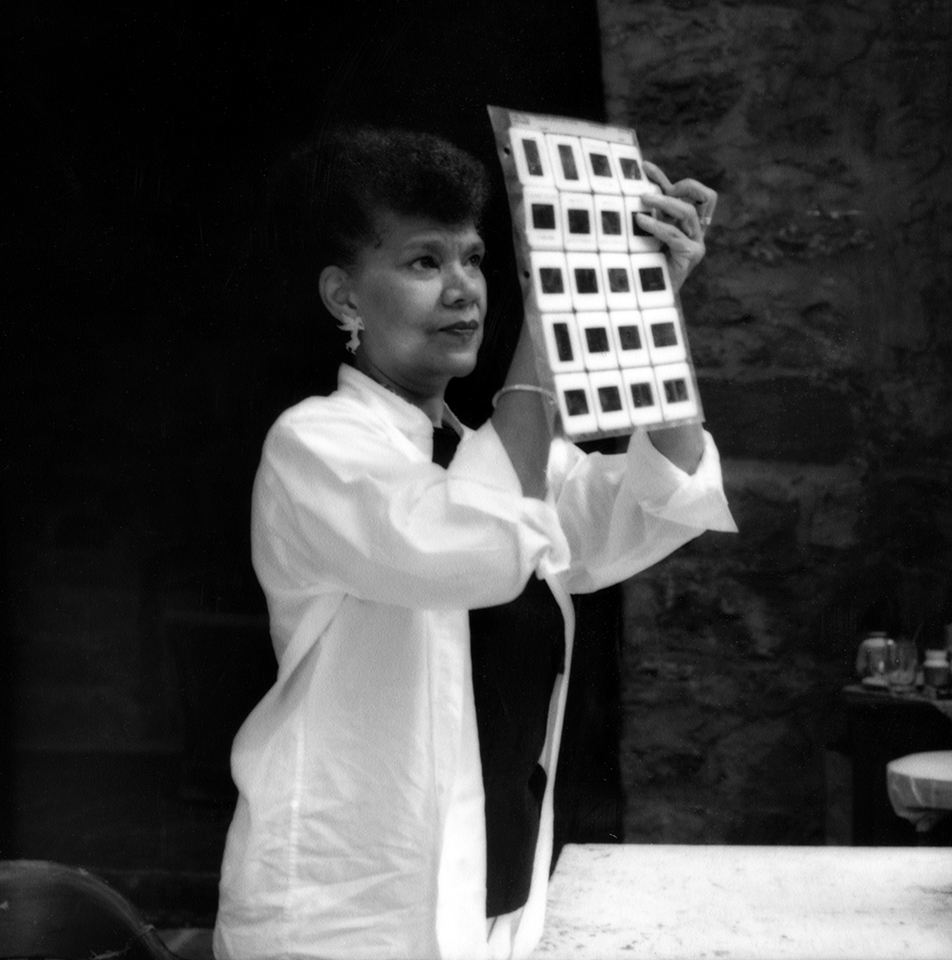
O’Grady working at the MacDowell residency in 1995.
From Mlle Bourgeoise Noire and Feminism (2007)
“Second-wave feminism was basically a white bourgeois construction that seemed to operate as though unconscious either that it was white or that it was middle-class. It was a time when white feminists could still believe that their definitions of sexual liberation and professional advancement applied identically to all women…and that they could speak for all women.”
“Black women were post-modernist avant la lettre.”
“Drop that lady-like mask! Forget all that self-controlled abstract art! Stop trying to be acceptable so you’ll get an invitation to the party!”
– Writing in Space, p. 110-111
From On Being the Presence That Signals an Absence (1993)
“Perhaps I had confused nudity and nakedness. For me, nudity is less about sex than about removing layers of culture; the bare head-and-shoulder portraits I have made feel as nude to me as do these lovers.”
– Writing in Space, p. 115-118

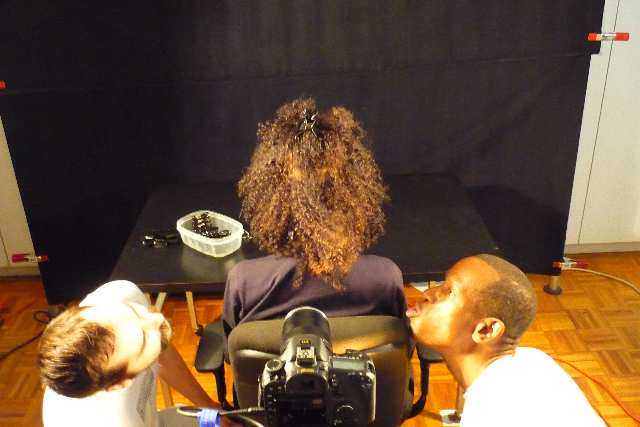
Studio production shots during the filming of Landscape (Western Hemisphere) in 2010.
From Some Thoughts on Diaspora and Hybridity (1994)
“For me, art is part of a project of finding equilibrium, of becoming whole. Like many bi- or tri-cultural artists, I have been drawn to the diptych or multiple, where much of the information happens in the space between, and like many, I have done performance and installation work where traces of the process are left behind.”
“‘Diaspora,’ a Greek word for the dispersion or scattering of peoples includes by extension the lessons that displaced peoples learn as they adapt to their hosts or captors. It is diaspora peoples’ straddling of origin and destination, their internal negotiation between apparently irreconcilable fields, that can offer paradigms for survival and growth in the next century.”
“… I do think that in a future of cultural crowding, the lessons of diaspora and hybridity can help us move beyond outdated originary tropes, teach us to extend our sensitivities from the inside to the outside, perhaps even help us maintain a sense of psychological and civic equilibrium.”
“In my performances and photo installations, I focus on the black female, not as an object of history, but as a questioning subject. In attempting to establish black female agency, I try to focus on that complex point where the personal intersects with the historic and cultural.”
– Writing in Space, p. 119-125
From Two Exhibits (1998,2018)
“Since Western dualism is hierarchical, there can’t be balance or equation: as good is not obverse of evil, full acknowledgement of both isn’t needed to achieve balance in the world. For harmony, good must simply rule evil.”
“Despite its name, the binary contains a hidden third term that accounts for the superiority of one side of the binary over the other. It’s the thing that has been ‘passed through,’ the thing that has been experienced or received, that makes it higher in value, like the blessing of Abel over Cain, or of Jacob over Esau. The Western binary isn’t really a two, it’s a three, with an implied beginning, middle, and end. It’s a narrative that goes from Fallen to Saved.”
“When you put two things that are related yet dissimilar in a position of equality on a wall, they set up a ceaseless and unresolvable conversation.”
– Writing in Space, p. 139-141
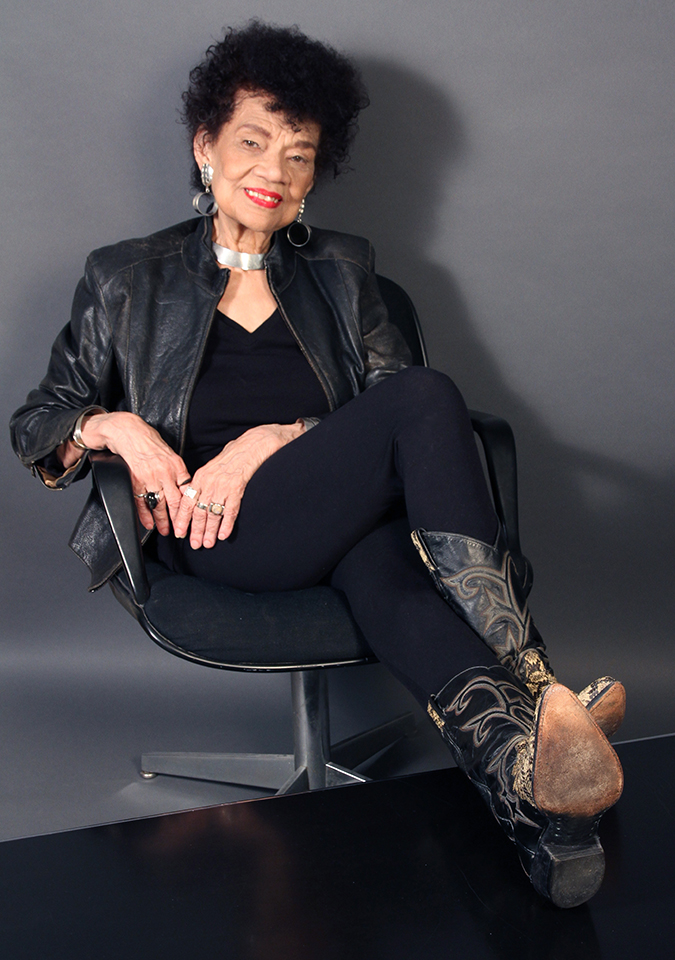
O’Grady at Elia Alba’s The Supper Club project in 2014. Photograph by Elia Alba.
From Introducing: O’Grady and Huxtable (2016)
“Just when we were beginning to be able to examine our own subjectivity, others were declaring subjectivity dead, of no interest because it was socially constructed. But how could we declare it dead until we’d had a chance, or taken time to examine it live?”
“Because power has the infinite capacity to resist, you find yourself making the same arguments over and over and over. You’re in this loop.”
“It always seemed that nobody else was thinking like me. But I always believed I was thinking in a way others would eventually have to think, I just didn’t know how long it would take.”
“So you start circling around, making the argument from different positions, using different methods. I think every bit of armor that you have, including writing, can and should be used…”
– Writing in Space, p. 142-165
From A Day at the Races (1993)
“Whenever ‘peripheral’ art is allowed to exist in a hegemonic context, it is derivative by definition, because it ‘enters as a consequence, not as an originator.’ If its originality can’t be reduced, the work is too discomfiting and must be ignored.”
– Writing in Space, p. 169-175
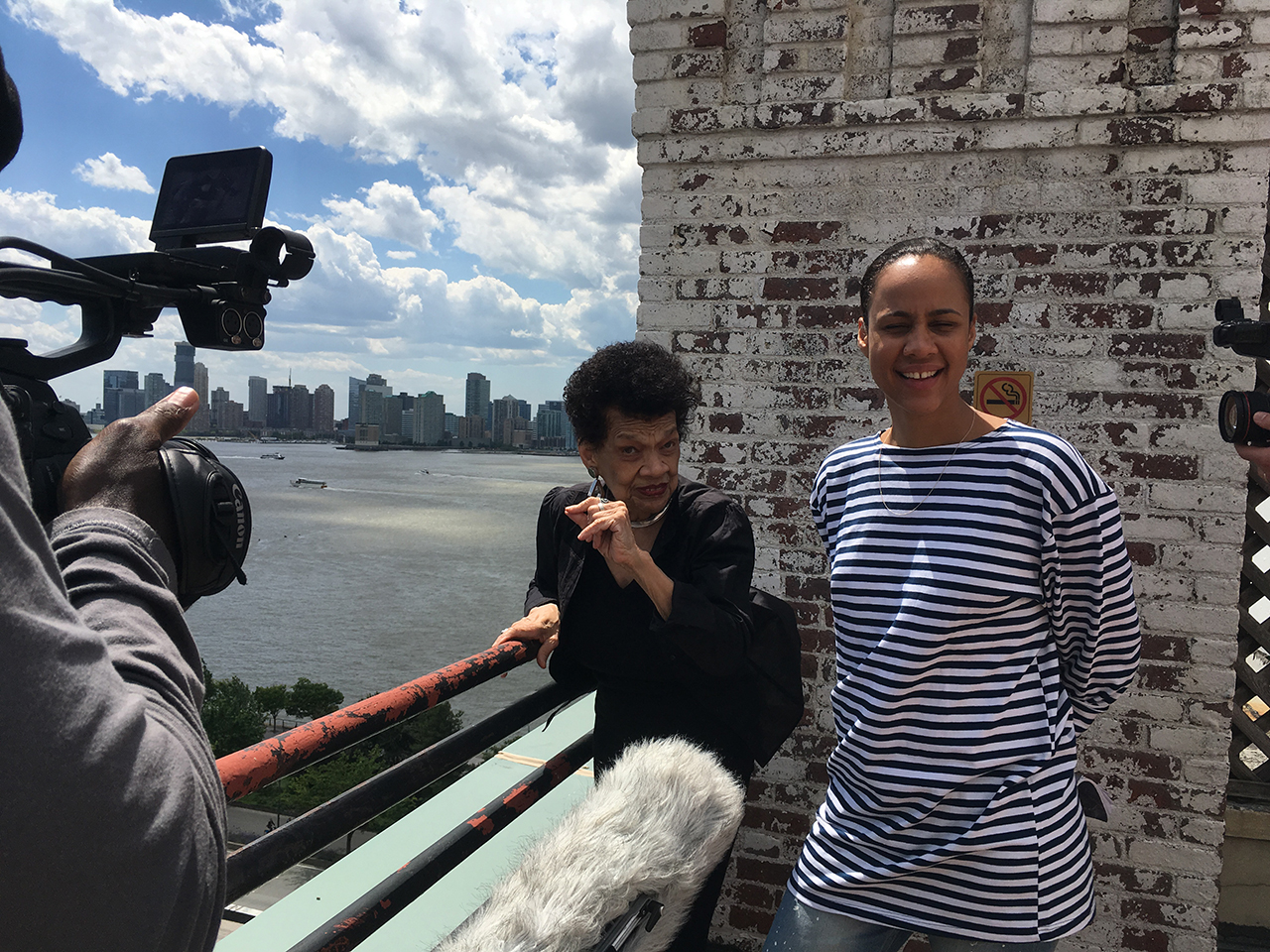
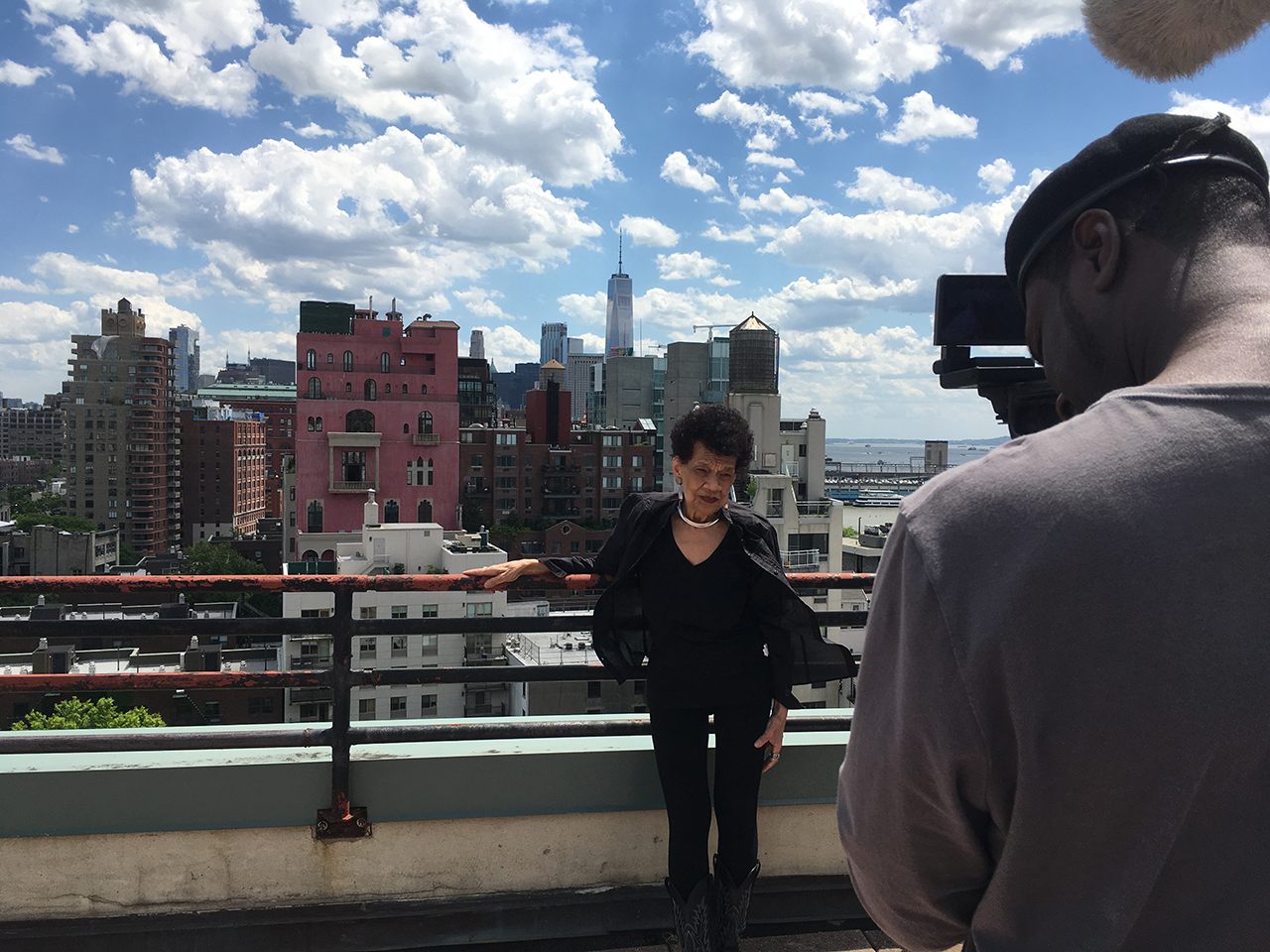
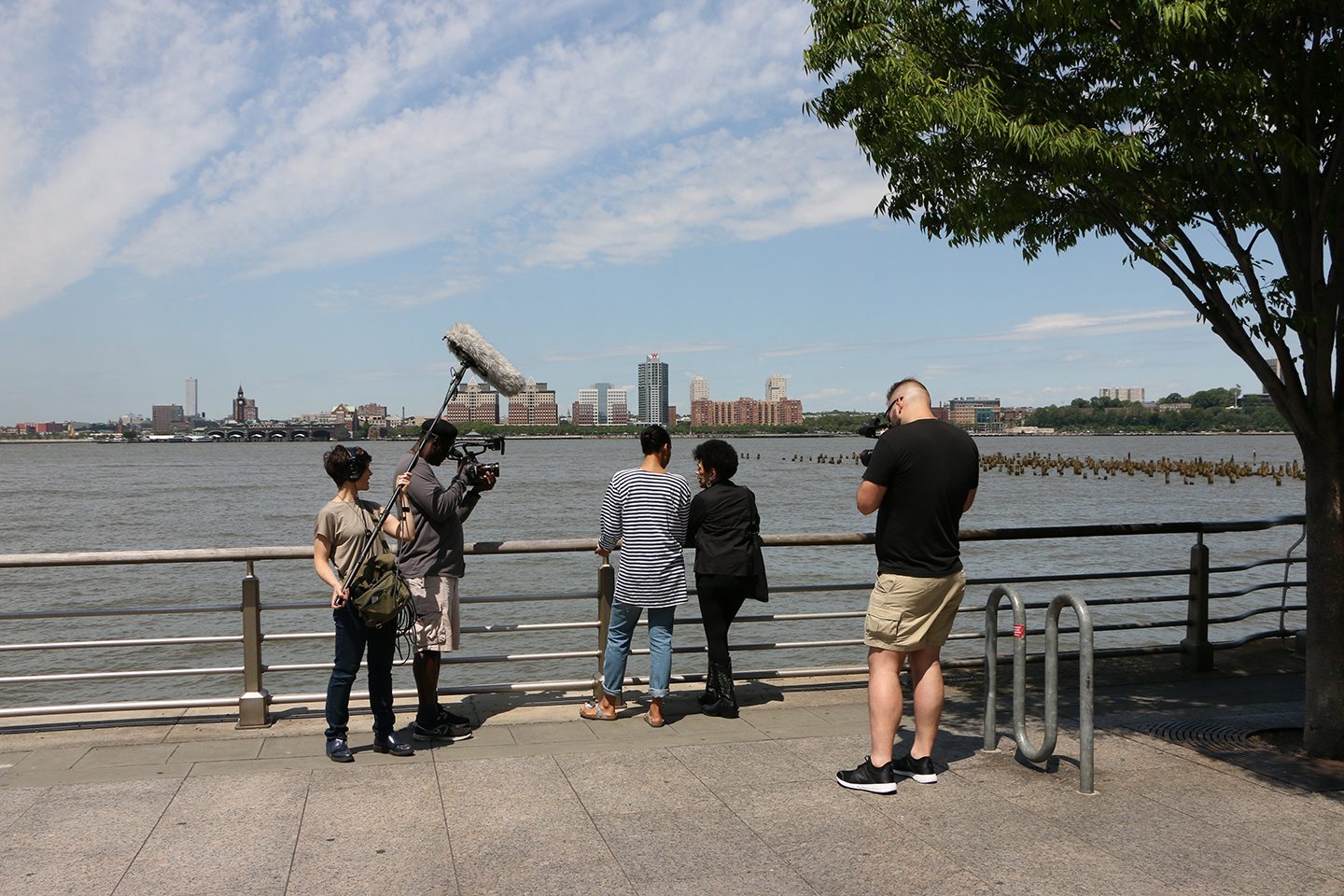
O’Grady with Zawe Ashton during the filming of Meeting Lorraine, a short documentary directed b Ashton, 2017. Photograph by Laura Lappi.
From Poison Ivy (1998)
“What we don’t need is the kind of unitary vocalization—one right point of view, one hip generation—that white culture seems to demand of us, so that it doesn’t have to think about us so much, so that we’re not too complicated.”
– Writing in Space, p. 181-183
From The Black and White Show, 1982 (2009)
“Getting reviewers to the gallery was like beating your head against air. The show received a single paragraph in the East Village Eye, nothing more.”
– Writing in Space, p. 184-197
From My 1980s (2012)
“Sadly, individual desire is one of the human qualities most easily and effectively structured by political economy, which is to say, power.”
“History as the single-minded story of the winners is something premodern and modern cultures have in common. But history has, in reality, always been just one story among many—and not always the most interesting, not always the most useful to the present. It was just the story that was needed to survive, to justify power, or the one capable of being understood with the mindset then available. I’d like to see the lost stories recuperated: stories to use, to amuse.”
“I often say I was ‘post-black’ before I was ‘black.’ For a long time, I felt that I had escaped the limitations imposed by blackness.”
“But sometimes you have to tell your own stories, not just to understand yourself but to understand the world, to find the space between their stories and your, to learn what’s really going on.”
“My newspaper poems were more of a sous-realite, an “under” reality. They were an effort to construct out of that random public language a private self, to rescue a kind of rational madness from the irrational Western culture I felt inundated by, in order to keep sane.”
“Will the arrival of the real postmodernism bring a moment when we are all finally just an ‘other’ of someone else’s other?”
– Writing in Space, p. 203-212
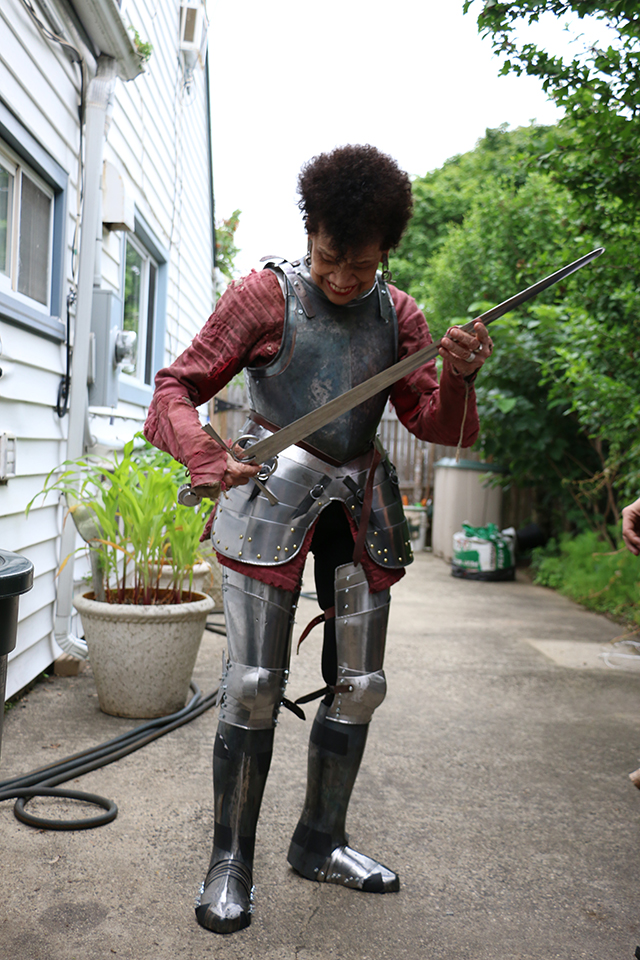
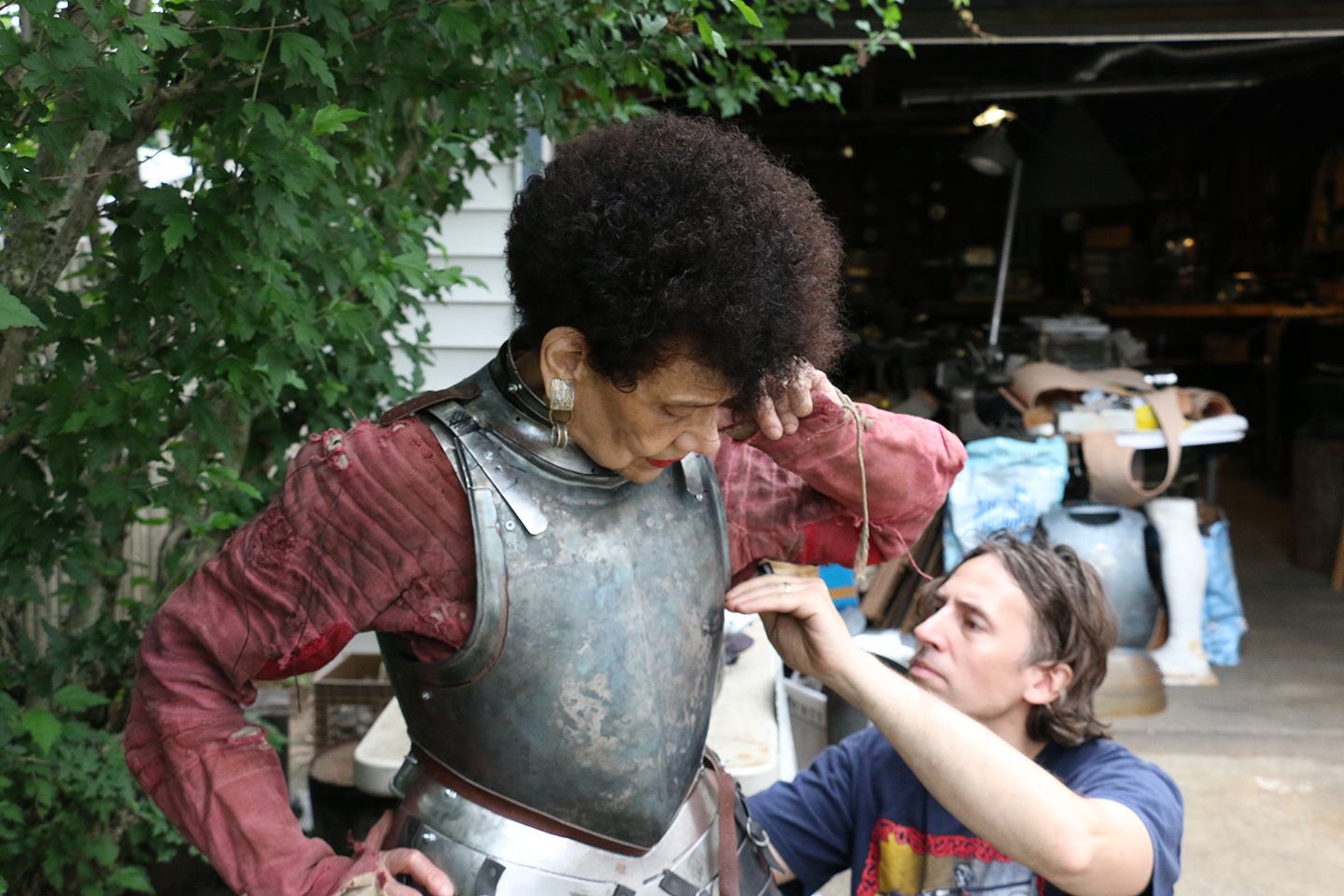
O’Grady fitting her armor at Wasson Artistry, 2015. Photograph by Laura Lappi.
From Interview with Laura Cottingham (1995)
“My mother’s idea was that I should major in history, go to Harvard Law School, and become the first black congressman. But I was always a rebel, and I rebelled against my background. I got pregnant and married in that order.”
“Wherever I went during those years of my intellectual formation and my early professional life, I was always “the only black women.” That was my identity.”
“My first piece was in 1980, when I came out as Mlle Bourgeoise Noire. It was a writerly statement in visual form, a critical statement, which is what most of my work became–or art as art criticism.”
“Unfortunately, any woman who continues in performance while she’s aging has got to deal with aging per se, and I had other arguments I preferred to make.”
“The anti-dualism of the diptych has always been at the heart of the work in some way. What has been happening is that the work has been focusing down, purifying itself into what is the most important argument I think I can make in art, which is against the dualism of Western culture.”
“Interracial sex, and the fear surrounding it, seems to me to be at the nexus of the country’s social forces. Within the various permutations, of course, the black male/white female is the most symbolically potent. It represents the fear of the loss of power; it is a negative symbol, if you will, embodying the very structure of white fear. The white male/black female (or the female of color all over the world) on the other hand, is the positive symbol of domination, an expression of what the power is FOR, rather than a reaction to the potential loss of power.”
“I don’t think racism could have the kind of intensity it has if it were simply, as the Marxists say, “an economic problem.” It is certainly an economic problem, precisely because it is a psychological problem, but the psychological precedes and makes the economic exploitation possible.”
“One of the biggest difficulties I have as an artist is how to present this explosive subject matter and still have the art paid attention to.”
“I think that the biggest problem that those of us have who are bi- or even tri-cultural and are trying to interpolate our positions with those of the West (a group that includes nearly all non-Afrocentric artists) is the way in which, both philosophically and practically, the West divides its ability to comprehend good/evil and black/white, the way it makes oppositions of everything. Not just simple oppositions, but hierarchical, superior/inferior oppositions, so that male/female, black/white, good/evil, body/mind, nature/culture are not just different, one is always better than.”
“For black women, freedom may be the ability to keep our clothes on if we want; historically, we’ve been forced to take our clothes off. But for white feminists, the situation is opposite. For them, the freedom to take their clothes off is critical, and that fact is reflected in the difference in the art that they produce.”
– Writing in Space, p. 219-238
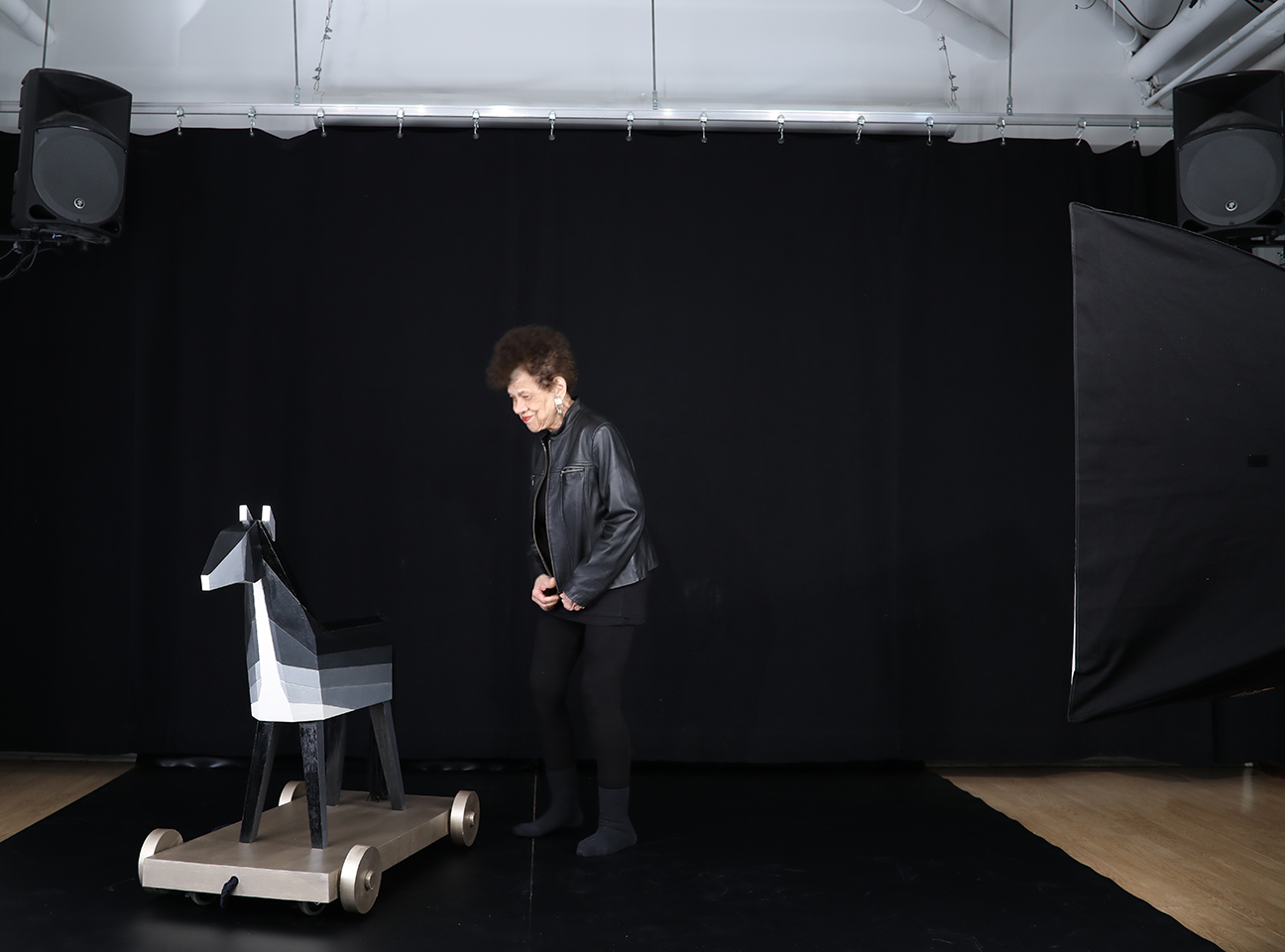
O’Grady during a photo shoot with Rociavant, her artistic persona’s horse, 2017. Photograph by Laura Lappi.
From Interview with Jarrett Earnest (2016)
“What studying Flannery did was make me understand that the work of the minority artist is the same wherever they are in the world: fighting to make their work understood. Flannery had to defend what she was doing, and thank god she understood that she had to defend it”
“The attitude to the physical body in performance art that’s accumulated the largest concentration of scholarship and the most definitive modes of teaching has seemed defined by the white woman’s revolt to take off her excessive clothing. That wasn’t really most black women’s rebellion.”
“I’m so aware that there are things about my work that may seem contradictory. On the one hand, I’ve not been interested in performing nude; on the other, at that time I was one of the few women using the black female nude in my two-dimensional work. What looks like inconsistency on the surface is something I’ve had to come to grips with: when you are the object of irrational contradictions, then you are in a position of having to struggle in contradictory ways. If you are simultaneously being seen as the universal prostitute, and at the same time as the sexless matriarch – the Jezebel and the Mammy – neither of which have anything to do with what you are, then sometimes you have to fight for the right not to be either, and sometimes for the right to be both at once.”
“I kept my clothes on while performing, and sometimes I took them off while making art. That contradiction is all over “Olympia’s Maid,” where the language can shift mid-sentence and take the opposite stand.”
“I’m old fashioned. I think art’s first goal is to remind us that we are human, whatever that is. I suppose the politics in my art could be to remind us that we are all human.”
“I don’t know that the nature of art itself has changed; I do think the idea of an “art career” has changed.”
“The inability of people to see the connections between the bodies of work, perhaps due to unfamiliarity with the issues, has been one of the most difficult parts of being an artist for me. One thing that keeps me going is to try and lasso all of this into a single, unique body of work that people will be able to see as that.”
– Writing in Space, p. 239-249

Parts of O’Grady’s armor.
From The Mlle Bourgeoise Noire Project, 1980-1983 (2018)
“Well, of course, a desperate situation can sometimes provoke and enable desperate actions. But I think that for everybody, agency isn’t something that you’re born with. It’s something that you learn and accept, and then act on. And it’s something that you have to keep learning.”
“When I put those gloves on, pinned them to my chest, it signaled my acceptance and acknowledgement that Mll Bourgeoise Noire was not just about them, it was also about me.”
“Art is…was not just a feel-good performance in Harlem. It was part of a larger conceptual art project of institutional critique, which I called the Mll Bourgeoise Noire project.”
“She was 45 when she first emerged, had had many other lives and lived in many other worlds, but she had never encountered a world as absolute segregated as the art world – where the segregation wasn’t simply social, it was also an intellectual and cultural form of segregation justified under the rubric of “quality.””
“I think that for me, gaining agency was mostly about accepting the best and the worst in myself, joining to my natural strengths the added strength of giving up pretenses of various (bourgeois and other) sorts.”
“For her, the whip was the sign of external oppression, the gloves were a sign of internal repression – how we internalize our oppression. So, she embodies both.”
“One thing I would like to point out is that even though the art world itself, or the institutional aspects of the art world, were rigorously segregated, the artists themselves were not so segregated. There were many conversations between artists of different races that were taking place, sotto voce, underneath the radar of the official art world.”
– Writing in Space, p. 250-259
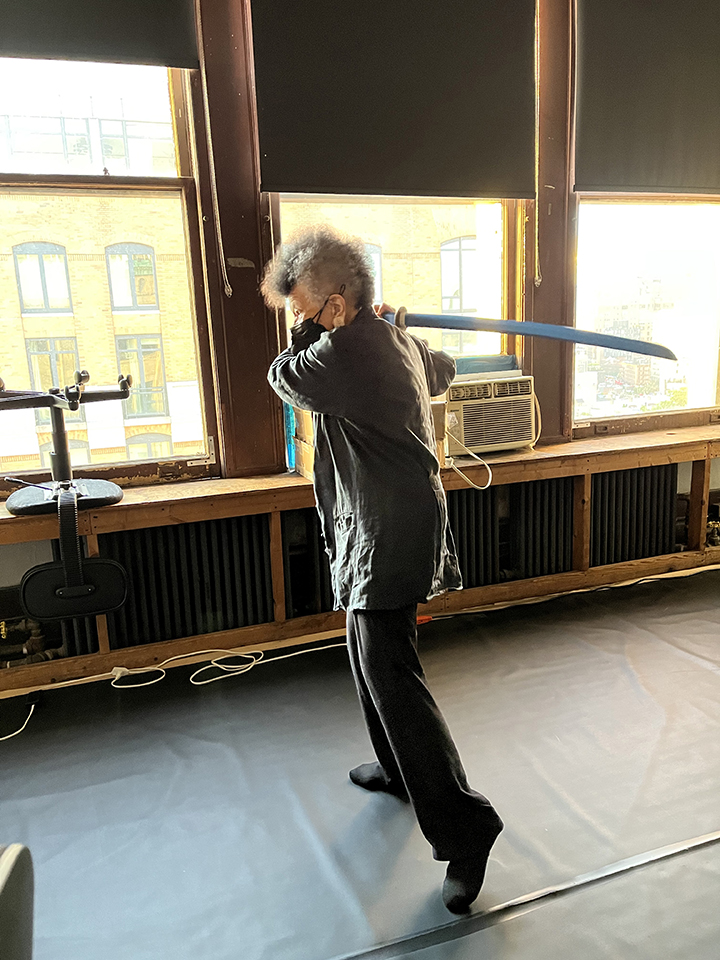
O’Grady practicing with a long Jungshin sword, 2022. Photograph by Ursula Davila-Villa.
From Job History (2004)
“The only desire I can remember having almost from the beginning was to express myself and make a mark. I had to take the plunge and commit to art.”
“Suffice to say, becoming and being an artist is the only challenge I’ve never tired of. I’m still here. But as for women’s issues, it’s the samo samo. […] ‘La lutte continue!’ as they say in French. The struggle goes on and on.”
– Writing in Space, p. 260-268
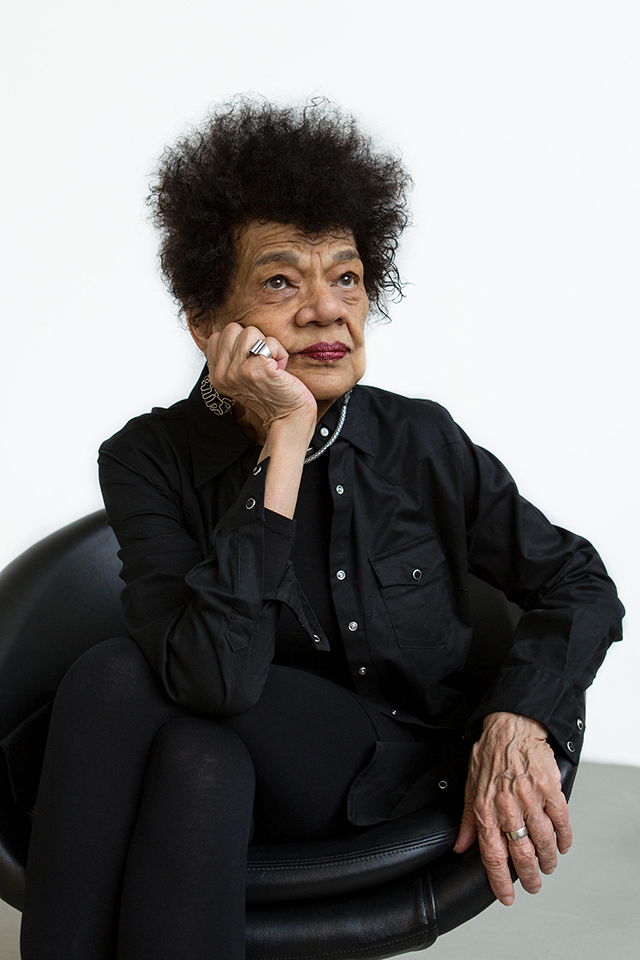
Lorraine O’Grady, 2018. Photograph by Ross Collab.
From Tate Modern, Meeting Lorraine, a Film by Zawe Ashton (2017)
Zawe Ashton: “Why do you think the art world is so slow when it comes to women of color?”
O’Grady: “We are the most extremely marginalized and so our voices are the voices that are the least heard.”
Zawe Ashton: “What did we do wrong?”
O’Grady: “I don’t know. Race and gender reflect each other in the most curious of ways. Most of us do prioritize race in terms of the order of discriminations, but we can’t forget that gender is also a form of discrimination so if you have two, then you’re doubly marginalized, right? If you’re both Black and a woman, you’re certainly at the bottom of the totem pole and so our voices were not worthy of being heard.”
Zawe Ashton: “Reading about you and reading your work and seeing your work has given me a greater understanding of myself.”
O’Grady: “One can’t ask for anything more than that really. Sometimes I think that making art is a way of sharing yourself and saying to others ‘it’s okay, it’s okay.’ You know? It’s a way of saying to others ‘you’re not alone.'”
Zawe Ashton: “How does it feel revisiting it now?” [The site of Rivers, First Draft]
O’Grady: “It’s not exactly as I remembered it so it’s a bit of a dislocation but I think I’ll be thinking about it for quite a while.”
“[On Rivers, First Draft] I think it’s my most revolutionary piece. That the idea of showing a Black woman becoming an artist in doubt and conflicted and all of that, that is in fact revolutionary because I think the images that we have of Black women to work with are either that they’re so downtrodden or they’re so powerful—it’s almost hard to relate to either end of that spectrum.”
“I think that everybody has parts of themselves that don’t seem to fit together and somehow or the other you have to make them fit together if you’re going to become a whole person.”
‘We need mirrors in order to see ourselves. If we’re not mirrored, we can’t. To our great envy, the young white artist could cobble themselves together out of so many different artists and we had so few to choose from.”
“I think it’s been a very important moment just now that we are beginning to see happening, where it’s not just one or two Black artists, it’s groups of Black artists with many different perspectives, many different backgrounds, many different journeys. None of us are speaking for everyone. We’re only speaking for our portion of reality, our own individual portion of reality and it’s all these artists’ voices together that make up the full picture.”
Zawe Ashton: “Thank you so much for everything. Past, present and future.”
– Tate Modern, link here